North Carolina Recording Laws Your 2026 Legal Guide
Are your recordings legal? Our 2026 guide to North Carolina recording laws covers one-party consent, penalties, and compliance for businesses and creators.
Kate
February 28, 2026
When it comes to recording conversations in North Carolina, the law boils down to one simple but powerful principle: one-party consent.
If you're an active participant in a conversation, you can legally hit the record button without getting permission from anyone else. But don't let that simplicity fool you. Getting this wrong can land you in serious legal hot water, including facing felony charges.
A Quick Guide To North Carolina Recording Laws
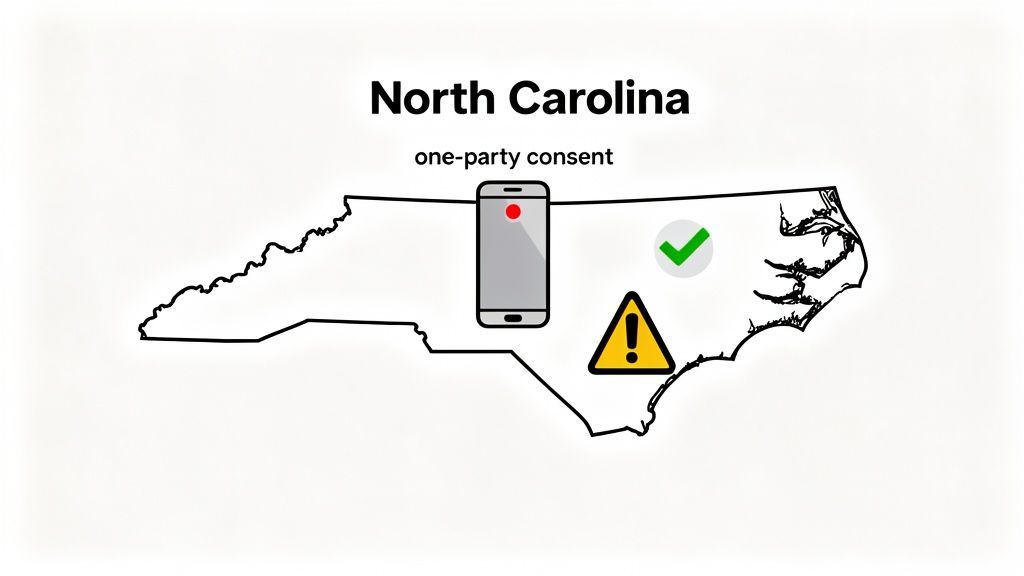
Think of North Carolina's law like this: as long as you're in the conversation, you're allowed to save a copy. It doesn't matter if you're talking face-to-face, on the phone, or over a video call. If at least one person involved knows it's being recorded—and that person can be you—you're generally in the clear.
This is a world away from the rules in about 11 other states that demand "all-party consent," where every single person has to agree. In North Carolina, the law is more flexible for participants but comes down hard on eavesdroppers. Secretly recording a private conversation you are not a part of is a felony.
The legal foundation for this is found in the North Carolina General Statutes § 15A-287, which covers the illegal interception of communications. This is the statute that makes unauthorized eavesdropping a serious crime and is the starting point for anyone looking to record compliantly.
North Carolina Recording Scenarios At-A-Glance
To help you see how this works in the real world, let's break down a few common scenarios. The core question is always the same: are you a part of the conversation?
Quick Compliance Checklist Before You Hit Record
Confirm You’re a Participant
Make sure you are actively speaking or being spoken to. Simply overhearing or standing nearby does not count legally.
Check Privacy Expectations
Closed rooms, offices, and private calls usually require caution. Public places often don’t carry the same protections.
Consider Other States
If anyone joins from another state, their laws may apply. When unsure, follow the strictest rule and get consent from everyone.
Secure the Recording
Store files safely and use a trusted transcription tool. Sensitive audio should never be uploaded to unsecured or unknown platforms.
Here's a quick summary of how the one-party consent rule applies.
| Recording Scenario | Consent Required | Key Takeaway |
|---|---|---|
| In-Person Conversation | One Party | If you are part of the discussion, you can legally record it. |
| Phone Call | One Party | You can record any phone call you are participating in. |
| Video Conference (Zoom, etc.) | One Party | Recording a video call you are on is permitted under the statute. |
The key takeaway is that as long as you are an active and known participant in the communication, North Carolina law permits you to record it. This rule applies consistently across different formats, from a casual chat in a coffee shop to a formal business call on Zoom.
Understanding The One-Party Consent Rule
While it’s true that North Carolina is a “one-party consent” state, the law isn't quite that simple. Its real-world application comes down to two crucial ideas: being a party to the conversation and whether there's a reasonable expectation of privacy.
Getting these two concepts right is the key to staying on the right side of the law and avoiding a serious legal headache.
So, what does it mean to be a "party to the conversation"? It means you are an active participant—you're part of the give-and-take. Simply being in the next room and overhearing a chat through the wall doesn't count. The law is there to let people keep a record of their own discussions, not to greenlight secret eavesdropping.
If you aren't speaking or being spoken to, you have no legal standing to record the private conversations of others. It’s a fundamental distinction.
Who Is A Party To The Conversation?
Let’s make this practical. Imagine a journalist conducting a phone interview. The journalist asks questions, and the source provides answers. Since the journalist is actively participating, they can legally record that call under North Carolina law without telling the source—though as a best practice, transparency is always a good idea.
Here's another one: a manager is holding a performance review with an employee. Both are parties to that conversation. Because they are directly involved in the dialogue, either of them could legally hit record in North Carolina.
Key Insight: The right to record belongs to those inside the conversation. If you’re just an outsider listening in, even if you’re physically nearby, you can't legally record without getting consent from at least one of the actual speakers.
These examples get to the heart of the matter: your legal right to record is tied directly to your active involvement. This is a core part of the state's wiretapping statute, N.C. Gen. Stat. § 15A-287, which makes it a crime for non-parties to intercept communications.
For a broader look at how these rules vary across the country, you can learn more about whether it is legal to record a conversation without consent in our detailed guide.
What Is A Reasonable Expectation Of Privacy?
The second pillar of North Carolina’s recording law is the "reasonable expectation of privacy." At its core, the law protects communications that are meant to be private. If a conversation takes place somewhere public where privacy can't be expected, the recording rules might not even apply.
Think of it like this: a heated argument shouted across a crowded park comes with zero expectation of privacy. Anyone walking by can overhear it, so recording it likely wouldn't break any wiretapping laws because it wasn't a private conversation to begin with.
On the other hand, a whispered chat between two colleagues in a closed office absolutely carries a high expectation of privacy. Secretly recording that conversation, especially if you aren't part of it, would almost certainly be illegal.
When courts have to decide if an expectation of privacy was "reasonable," they often look at a few things:
- The setting: Was it a public park or a private home?
- The volume: Were people shouting or whispering?
- The effort to be private: Did the speakers close a door or find a secluded corner?
This concept explains why silent video surveillance of a public-facing area is often perfectly legal, but adding audio to that same camera could be a felony. The audio captures private conversations, which get much stronger legal protection than video of a public space. It’s a critical difference for anyone using security systems or other recording gear.
Navigating In-Person, Phone, And Video Recording
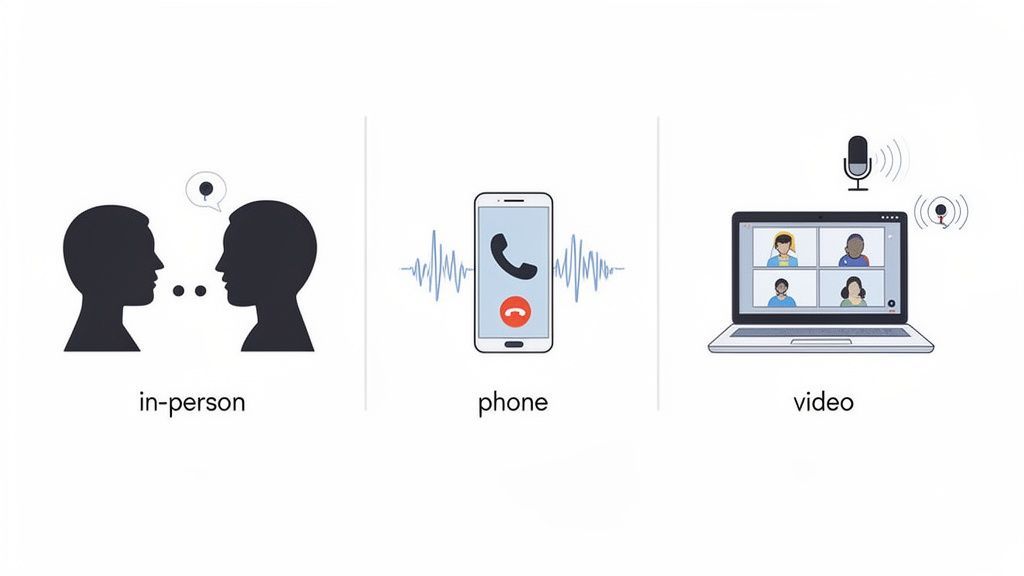
Whether you’re talking face-to-face, over the phone, or on a video call, North Carolina's one-party consent rule applies. But the specific technology you use can add new layers of complexity, and understanding these nuances is what keeps you compliant.
Recording a conversation you’re part of is usually pretty straightforward under North Carolina recording laws. Same goes for a phone call you're on. It's generally allowed. If you need a refresher on the technical side of things, our guide on how to properly record a phone call walks you through the steps.
Where things get tricky is with video and calls that cross state lines.
Turn Every Conversation into Clear, Searchable Text
State-of-the-art AI
Powered by OpenAI's Whisper for industry-leading accuracy. Support for custom vocabularies, up to 10 hours long files, and ultra fast results.

Import from multiple sources
Import audio and video files from various sources including direct upload, Google Drive, Dropbox, URLs, Zoom, and more.

Speaker detection
Automatically identify different speakers in your recordings and label them with their names.
Here's a quick summary of how the one-party consent rule applies.
| Recording Scenario | Consent Required | Key Takeaway |
|---|---|---|
| In-Person Conversation | One Party | If you are part of the discussion, you can legally record it. |
| Phone Call | One Party | You can record any phone call you are participating in. |
| Video Conference (Zoom, etc.) | One Party | Recording a video call you are on is permitted under the statute. |
The key takeaway is that as long as you are an active and known participant in the communication, North Carolina law permits you to record it. This rule applies consistently across different formats, from a casual chat in a coffee shop to a formal business call on Zoom.
Understanding The One-Party Consent Rule
While it’s true that North Carolina is a “one-party consent” state, the law isn't quite that simple. Its real-world application comes down to two crucial ideas: being a party to the conversation and whether there's a reasonable expectation of privacy.
Getting these two concepts right is the key to staying on the right side of the law and avoiding a serious legal headache.
So, what does it mean to be a "party to the conversation"? It means you are an active participant—you're part of the give-and-take. Simply being in the next room and overhearing a chat through the wall doesn't count. The law is there to let people keep a record of their own discussions, not to greenlight secret eavesdropping.
If you aren't speaking or being spoken to, you have no legal standing to record the private conversations of others. It’s a fundamental distinction.
Who Is A Party To The Conversation?
Let’s make this practical. Imagine a journalist conducting a phone interview. The journalist asks questions, and the source provides answers. Since the journalist is actively participating, they can legally record that call under North Carolina law without telling the source—though as a best practice, transparency is always a good idea.
Here's another one: a manager is holding a performance review with an employee. Both are parties to that conversation. Because they are directly involved in the dialogue, either of them could legally hit record in North Carolina.
Key Insight: The right to record belongs to those inside the conversation. If you’re just an outsider listening in, even if you’re physically nearby, you can't legally record without getting consent from at least one of the actual speakers.
These examples get to the heart of the matter: your legal right to record is tied directly to your active involvement. This is a core part of the state's wiretapping statute, N.C. Gen. Stat. § 15A-287, which makes it a crime for non-parties to intercept communications.
For a broader look at how these rules vary across the country, you can learn more about whether it is legal to record a conversation without consent in our detailed guide.
What Is A Reasonable Expectation Of Privacy?
The second pillar of North Carolina’s recording law is the "reasonable expectation of privacy." At its core, the law protects communications that are meant to be private. If a conversation takes place somewhere public where privacy can't be expected, the recording rules might not even apply.
Think of it like this: a heated argument shouted across a crowded park comes with zero expectation of privacy. Anyone walking by can overhear it, so recording it likely wouldn't break any wiretapping laws because it wasn't a private conversation to begin with.
On the other hand, a whispered chat between two colleagues in a closed office absolutely carries a high expectation of privacy. Secretly recording that conversation, especially if you aren't part of it, would almost certainly be illegal.
When courts have to decide if an expectation of privacy was "reasonable," they often look at a few things:
- The setting: Was it a public park or a private home?
- The volume: Were people shouting or whispering?
- The effort to be private: Did the speakers close a door or find a secluded corner?
This concept explains why silent video surveillance of a public-facing area is often perfectly legal, but adding audio to that same camera could be a felony. The audio captures private conversations, which get much stronger legal protection than video of a public space. It’s a critical difference for anyone using security systems or other recording gear.
Navigating In-Person, Phone, And Video Recording
Whether you’re talking face-to-face, over the phone, or on a video call, North Carolina's one-party consent rule applies. But the specific technology you use can add new layers of complexity, and understanding these nuances is what keeps you compliant.
Recording a conversation you’re part of is usually pretty straightforward under North Carolina recording laws. Same goes for a phone call you're on. It's generally allowed. If you need a refresher on the technical side of things, our guide on how to properly record a phone call walks you through the steps.
Where things get tricky is with video and calls that cross state lines.
The Critical Difference Between Video And Audio
Here’s a distinction that trips a lot of people up: video versus audio. It’s a common mistake to think that if you can legally place a security camera somewhere, you can also record whatever it hears. That assumption is flat-out wrong—and dangerous.
Silent video recording in places with no reasonable expectation of privacy—think the front of a retail store or a public-facing driveway—is usually fine. But the second you capture audio on that video feed, you’ve just stepped into wiretapping territory. Audio captures private conversations, which get far more legal protection.
Key Takeaway: Adding audio to video transforms simple surveillance into potential wiretapping. If your camera records private conversations you aren't a part of, you could be committing a felony.
For instance, a security camera on your porch capturing silent video of your property is perfectly legal. But if that same camera records the private chat of your neighbors walking past on the public sidewalk, you’ve likely broken the law.
Recording Zoom And Other Online Meetings
In today's world, platforms like Zoom and Microsoft Teams have become our new conference rooms. North Carolina's one-party consent rule still applies. If you're a participant in the meeting, you can legally hit record.
But just because you can record secretly doesn't mean you should. Transparency is always your best bet.
- Announce It Upfront: Start the meeting with a simple, "Just a heads-up, I'll be recording this call so we can focus on the conversation instead of notes."
- Use Built-In Tools: Most platforms have automatic notifications that tell everyone when a recording starts. Lean on these features.
- Build Trust: Announcing recordings fosters an open environment and avoids the suspicion and awkwardness that come with discovering a secret recording later.
This isn’t just good etiquette; it’s smart risk management, especially when you have people joining from different states.
The Challenge Of Multi-State Conference Calls
This is where the legal landscape gets really murky. Imagine you're in Raleigh (a one-party state) on a call with a colleague in Texas (also one-party) and another in Florida (an all-party state).
You might be in the clear based on your location, but your colleague in Florida is protected by their state's much stricter laws. In an all-party consent state, every single person on the line has to agree to the recording. No exceptions.
This table breaks down the core difference.
One-Party vs. All-Party Consent States
A comparative look at the recording laws in North Carolina versus states that require consent from all parties involved in a conversation.
| Legal Standard | North Carolina (One-Party) | All-Party States (e.g., California, Florida) |
|---|---|---|
| Consent Required | Only one participant needs to consent. This can be the person doing the recording. | Every participant must give their consent to be recorded. |
| Example | You can record a call with a colleague without informing them. | You must get explicit permission from all colleagues before you can record. |
| Interstate Calls | You're legally vulnerable if anyone on the call is in a stricter state. | Your state's stricter law sets the standard for calls you make or receive. |
Since there's no definitive federal ruling on which state's law wins in these scenarios, the universal advice from legal experts is to always follow the strictest applicable law. In our example, that means you'd need to follow Florida’s all-party rule.
The only truly safe path forward is to get explicit consent from everyone on the call, no matter where they are. A quick announcement at the start and getting a "yes" from all attendees is all it takes to protect yourself from any potential legal trouble.
Criminal And Civil Penalties For Illegal Recording
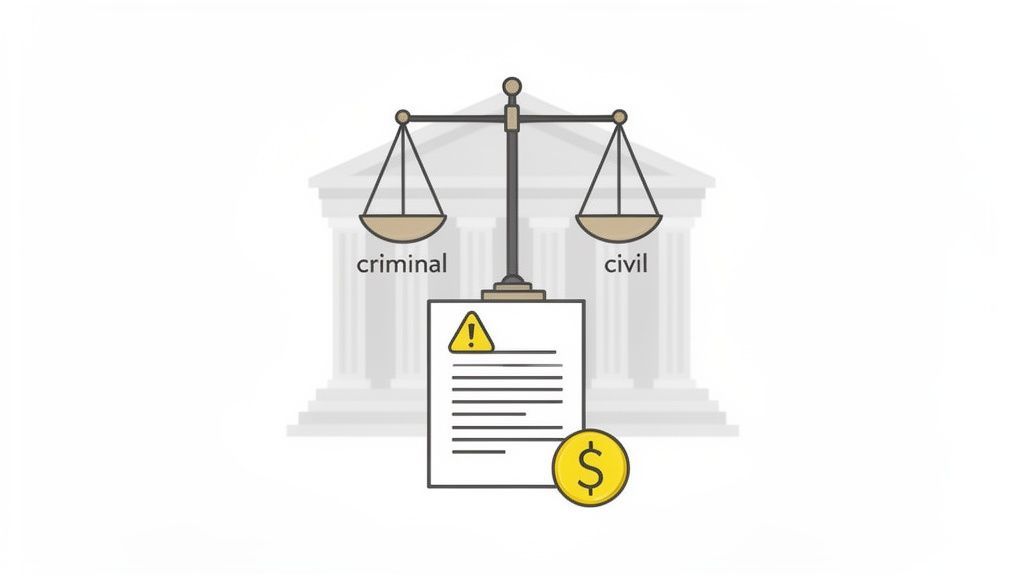
If you’re thinking about recording a conversation in North Carolina without consent, it's critical to understand what’s at stake. This isn't a minor slip-up that results in a simple fine. The consequences are severe, carrying both criminal and civil penalties that can follow you for years.
The law treats illegal recording with extreme seriousness. It’s not just a legal theory; it’s about tangible, life-altering consequences. Let's break down exactly what that means.
Think Before You Record - It Could Be Illegal
Secretly recording a private conversation you aren’t part of can lead to criminal charges. You may face prison time, heavy fines, and a permanent record. When in doubt, always get consent first.
The Criminal Consequences
Under North Carolina law, illegally recording a private conversation isn't a misdemeanor. It's a Class H felony. That classification is a big deal, putting the offense on the same level as serious crimes like certain types of assault and larceny.
The trouble doesn't just stop with hitting the record button. It’s also a Class H felony to intentionally use or share the contents of an illegally intercepted recording. So, even if you weren't the one who made the recording, just passing it along could land you in the exact same hot water.
A conviction for a Class H felony can lead to:
- Significant prison time: Depending on your criminal history, you could face a sentence ranging from several months to a few years behind bars.
- Substantial fines: On top of jail time, the court can impose heavy financial penalties.
- A permanent criminal record: A felony on your record can haunt you for life, impacting your ability to get a job, secure housing, or even own a firearm.
If you find yourself facing these kinds of charges, the stakes are far too high to go it alone. Speaking with a qualified criminal defense attorney is essential to protect your rights.
The Civil Repercussions
On top of potential criminal charges from the state, you can also be sued directly by the person you recorded. North Carolina law gives victims of illegal recording a powerful way to seek financial justice in civil court. This means you could be fighting a legal battle on two fronts simultaneously.
A victim of illegal recording can sue the offender for financial compensation. This opens up a second front of legal and financial risk that exists entirely separate from the criminal case.
In a civil lawsuit, a victim can demand several kinds of damages.
Available Civil Damages:
- Actual Damages: This is straightforward compensation for any real financial harm the victim suffered because of the illegal recording.
- Punitive Damages: These are designed to punish you for the act and deter others from doing it. Punitive damages can often be much, much higher than the actual damages.
- Attorney's Fees: The court can also order you to pay the other side's legal bills, which can easily run into tens of thousands of dollars.
The combination of felony charges and the risk of a massive civil lawsuit makes compliance a non-negotiable issue. This responsibility extends to how you handle the recordings afterward, especially during transcription. It's vital to know how to manage data security, and you can learn more about protecting sensitive information in our guide to recording privacy.
While North Carolina’s one-party consent rule is the bedrock of recording law, it’s not an ironclad guarantee for every situation. Things get a lot more nuanced in specific contexts.
Think of the one-party rule as the foundation. But several important layers—like public transparency, employer rights, and police duties—add complexity you can't afford to ignore.
Recording Public Officials and Meetings
What happens when you’re talking to a government official or attending a public meeting? In these cases, the "reasonable expectation of privacy" argument gets a whole lot weaker.
As a general rule, you can record events like a city council meeting or a public hearing without asking for permission. These are public forums by design, and the law leans heavily toward transparency and accountability.
But that doesn't mean you can secretly record every government employee. A private chat with an official in their office, disconnected from a public proceeding, would almost certainly fall back under the standard one-party consent rule. Context is everything.
Workplace Recordings and Employer Policies
The workplace is another minefield. While state law allows you, as a party to the conversation, to record a meeting with your boss, your company’s internal policies might say otherwise.
Many businesses have strict rules against recording conversations on company property or with company-owned devices. Breaking that rule might not land you in legal trouble with the state, but it can absolutely get you fired.
Key Insight: A recording can be 100% legal under state law and still be a fireable offense. Your employee handbook creates a separate set of rules you agree to follow as a condition of employment.
Before you hit record on a workplace conversation, check your company policies. Your rights under state law won't shield you from internal disciplinary action.
Security Cameras and Private Property
Security cameras bring up a crucial difference between video and audio. As we've covered, silent video capturing areas without an expectation of privacy—like your own front porch—is generally fine.
The game changes the second you add audio. A security camera that records the private conversations of neighbors walking by could trigger wiretapping laws, potentially leading to a felony. If you plan to capture audio with your security system, you better have a clear legal reason, which usually means you are an active participant in the conversations being recorded.
The Special Case of Law Enforcement Interrogations
Here's where the script gets completely flipped. When it comes to law enforcement, the law doesn't just allow recording—it demands it.
Under N.C. Gen. Stat. § 15A-211, police are required to make a complete audio and video recording of any custodial interrogation for a suspect in a serious felony case.
This mandate was expanded back in 2011 to cover not just homicides but also all juveniles and suspects in a broad range of other serious crimes. This creates a massive amount of crucial audio and video evidence that attorneys, judges, and juries rely on. You can learn more about the specifics of North Carolina's interrogation recording statute on NACDL.org.
What if an officer fails to record an interrogation? The consequences can be huge. A defense attorney will argue that any unrecorded confession was coerced or unreliable. Juries are even instructed to view the lack of a recording with suspicion, which can get a suspect's statements thrown out entirely. It’s a powerful example of how recording compliance directly shapes legal outcomes.
How to Record and Transcribe Legally
Knowing the rules is one thing, but actually putting them into practice is what really counts. For podcasters, businesses, journalists, and researchers, the real win comes from bridging the gap between legal theory and compliant action. It’s not just about understanding North Carolina recording laws; it’s about adopting habits that build trust and protect sensitive information every step of the way.
While North Carolina’s one-party consent rule gives you the green light to record conversations you’re a part of, the smartest and safest move is always to get explicit consent. Being transparent clears up any legal gray areas, especially on calls with people in different states, and it just makes for a more professional and open conversation.
Best Practice: Consent Builds Trust
Even when the law permits recording, being transparent helps prevent misunderstandings and reduces potential conflict. Obtaining clear consent not only protects you legally but also strengthens your professional credibility. When people are aware they’re being recorded and understand the purpose, they tend to communicate more openly and confidently, creating a more respectful and trustworthy environment.
Getting Explicit Consent
Getting consent doesn't need to be some stuffy, complicated legal script. A simple, clear heads-up at the beginning of any recorded conversation is all it takes.
You can use straightforward language like:
- "Just so everyone is aware, I'm recording this call for our records."
- "Before we begin, I want to let you know this meeting is being recorded."
- "To make sure I capture all the details, I'll be recording our conversation. Is that okay with everyone?"
That last part is key. Always wait for a verbal "yes" or "that's fine" from everyone involved. This simple exchange removes any doubt and gives you clear, documented consent that protects you from potential legal headaches down the road.
Securing Your Recordings with Compliant Transcription
Once you have a legally recorded conversation, your job isn't over. The next step is handling that data securely, especially when you’re turning it into a written transcript. A transcript can hold just as much sensitive information as the original audio, which makes your choice of transcription service a critical decision.
Turn Recordings Into Secure, Usable Notes
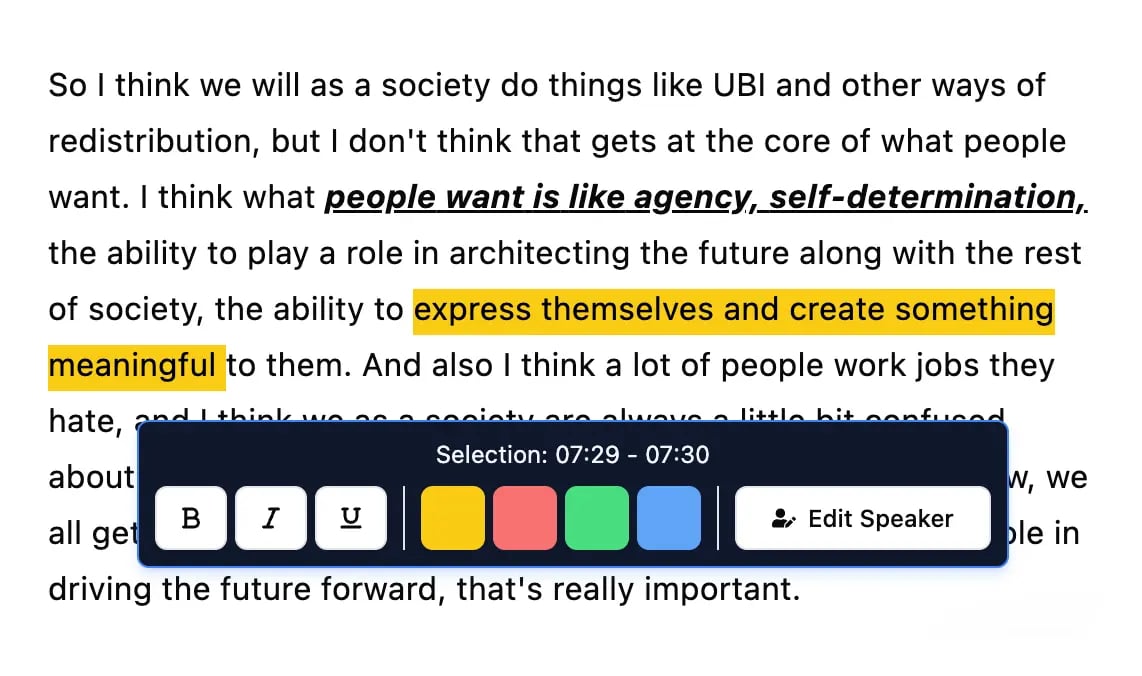
Editing tools
Edit transcripts with powerful tools including find & replace, speaker assignment, rich text formats, and highlighting.
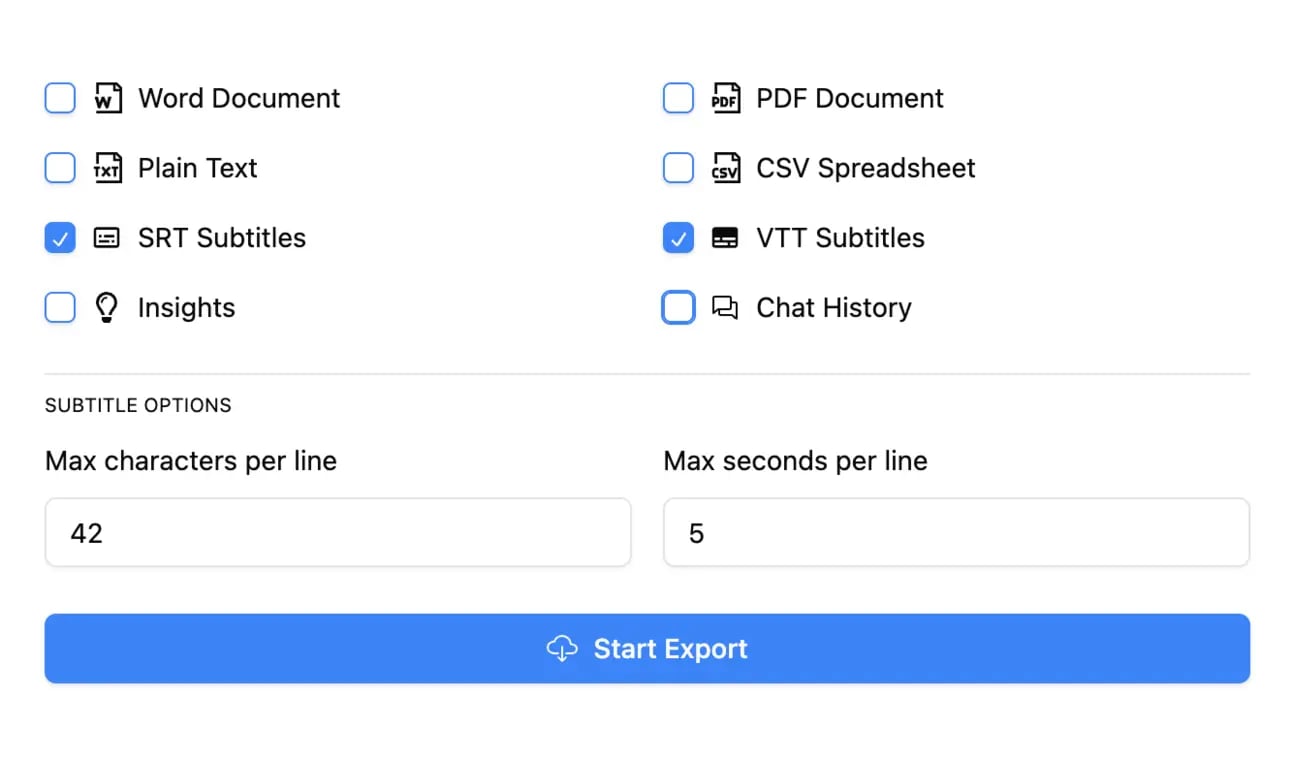
Export in multiple formats
Export your transcripts in multiple formats including TXT, DOCX, PDF, SRT, and VTT with customizable formatting options.
Summaries and Chatbot
Generate summaries & other insights from your transcript, reusable custom prompts and chatbot for your content.
This screenshot shows how a modern transcription tool can handle various file types securely.
This kind of flexibility shows why it's so important to use a platform built for both convenience and security. After recording, you need a service that protects the integrity of your data from the moment you upload it to the moment you export the transcript. To learn more about the process, you can explore our guide on how to transcribe conversations compliantly and efficiently.
When you're dealing with sensitive discussions, you have to find a service with a solid privacy policy.
Crucial Feature: A transcription service with a strict no-training-on-user-data policy is essential. This guarantees your private conversations aren't being fed into AI models, keeping your confidential information protected and under your control.
For those looking for a little more legal help in navigating recording laws or ensuring compliance, platforms like LegesGPT offer some valuable AI-powered legal software tools.
Ultimately, your goal is a complete, compliant workflow. It starts with getting clear consent, continues with making a clean recording, and finishes with using a secure platform like Transcript.LOL to turn that audio into an accurate, private, and usable text record. By following these practical steps, you can confidently and legally document your most important conversations.
Frequently Asked Questions About NC Recording Laws
Even when you have a good handle on the basics, real-life situations always bring up tricky questions about North Carolina recording laws. Let's walk through some of the most common scenarios to help you connect the rules to the real world.
Can I Legally Record a Conversation with My Boss?
Yes. Because North Carolina is a one-party consent state, you can legally record a conversation that you are a part of—including one with your boss—without telling them. As an active participant, your consent is all that's required.
But here's a word of caution: just because it's legal doesn't mean it's a good idea. Many companies have policies in their employee handbooks that strictly forbid recording conversations at work. Violating those internal rules could get you fired, and the legality of the recording won’t protect your job.
What Happens If I Record a Call with Someone in an All-Party State?
This is a classic "what if" that trips a lot of people up. Let's say you're in North Carolina (a one-party state) and you hop on a video call with someone in California or Florida (both all-party states). Which law applies?
To stay out of trouble, you have to follow the stricter law. That means you would need to get consent from everyone on the call.
Since there's no clear-cut federal rule that says one state's law overrules another's in these situations, the only safe bet is to default to the most restrictive one. Announce that the call is being recorded and get a clear "yes" from every single person before you proceed.
The Golden Rule for Interstate Calls: When state laws clash, always follow the strictest one. In practice, that almost always means getting consent from all parties.
Is a Legally Obtained Recording Admissible in Court?
Generally, yes. If you made a recording that complies with North Carolina's one-party consent rule, it's usually admissible as evidence in court. Of course, it still has to meet other standards, like being relevant to the case and properly authenticated.
An illegally made recording, on the other hand, is a different story. Not only will it be thrown out of court, but it could also land you in hot water with criminal charges.
Do I Need a Sign If My Security Camera Records Audio?
You almost certainly do. While a security camera that only records silent video of your own property is typically fine, the moment you add audio, you step into wiretapping territory. If your camera is in a position to pick up private conversations from people who aren't on your property—like neighbors chatting or people walking by on a public sidewalk—you are on very shaky legal ground.
To stay compliant, your best move is to post clear and visible signs stating that audio is being recorded. This acts as a notification, and anyone who stays in the area is considered to have given implied consent.
Remember, your job isn't done once you hit the "stop" button. Handling the recording securely is just as critical. With Transcript.LOL, you can turn your legally recorded audio into accurate and searchable text, all on a platform built to protect your privacy. Give it a try and get your first transcript on us.