Knowledge Sharing in Organizations: Maximize Collaboration
Discover knowledge sharing in organizations and unlock your team's potential with practical strategies that boost collaboration and drive innovation.
Kate, Praveen
December 17, 2025
Effective knowledge sharing in organizations isn't just a corporate buzzword; it's the art of capturing, sharing, and actually using the collective wisdom of your entire team. It's about turning individual expertise and those fleeting "aha!" moments from meetings into a company asset that lasts—one that stops people from constantly reinventing the wheel and lets innovation flourish.
Why Trapped Knowledge Is Costing Your Company

Think of it like this: your company is a library, but every book is written in invisible ink that vanishes after a single read. That’s what happens when there's no system for sharing knowledge.
Brilliant ideas from a brainstorm, hard-won lessons from a project wrap-up, or critical insights from an expert’s training call all evaporate the second the meeting ends. This isn't just a minor hassle. It’s a massive drain on your resources.
Your team wastes hours hunting for information they know exists somewhere. They re-solve problems that were already figured out last quarter. They make decisions without the full picture. We've all been there: you need an answer, you’re sure someone has it, but you have no clue who to ask or where to even begin looking.
The Real Cost of Information Silos
These invisible walls between teams and individuals—what we call information silos—are pure friction and waste. When knowledge gets trapped, the organization basically develops amnesia. It forgets its own wins and, worse, its own mistakes.
The financial hit from this is staggering. Poor knowledge sharing is a productivity black hole. One study found that companies lose a jaw-dropping $44.7 million annually—that breaks down to $40.6 million from delays in sharing information and another $4.2 million from inefficient onboarding. That's a huge price to pay for disorganization.
An organization's ability to learn, and translate that learning into action rapidly, is the ultimate competitive advantage. — Jack Welch, Former CEO of General Electric
This cycle of lost information hits the bottom line directly. It slows down projects, holds back employee growth, and suffocates the creative problem-solving you need to stay competitive. Tearing down these walls isn't just a nice-to-have; it's essential for survival.
To see just how different the outcomes can be, here’s a quick comparison:
The Impact of Effective vs. Ineffective Knowledge Sharing
| Area of Impact | Ineffective Knowledge Sharing (Silos) | Effective Knowledge Sharing (Connected) |
|---|---|---|
| Productivity | Constant reinvention of the wheel, wasted time searching | Accelerated workflows, faster problem-solving |
| Innovation | Stagnant ideas, limited cross-pollination | Creative solutions emerge from diverse perspectives |
| Employee Onboarding | Steep learning curves, reliance on busy mentors | New hires get up to speed quickly with accessible resources |
| Decision-Making | Based on incomplete or outdated information | Informed, data-driven decisions made with confidence |
| Employee Morale | Frustration, feeling of being unsupported | Empowerment, culture of collaboration and mutual support |
The difference is night and day. Moving from a siloed environment to a connected one unlocks potential that was always there, just hidden.
Turning Conversations into Company Assets
The solution is to stop letting all that valuable knowledge disappear. Every meeting, every interview, every presentation is packed with insights that, if captured, could serve the entire company for years to come. The goal is to build a collective brain that gets smarter with every single conversation.
This is where modern AI-powered tools come in. They can capture the gold hidden in conversational data and make it instantly searchable and useful. By putting solid knowledge management best practices into place, you can create a central nervous system for your company's information.
AI Tools That Capture Knowledge Automatically
State-of-the-art AI
Powered by OpenAI's Whisper for industry-leading accuracy. Support for custom vocabularies, up to 10 hours long files, and ultra fast results.
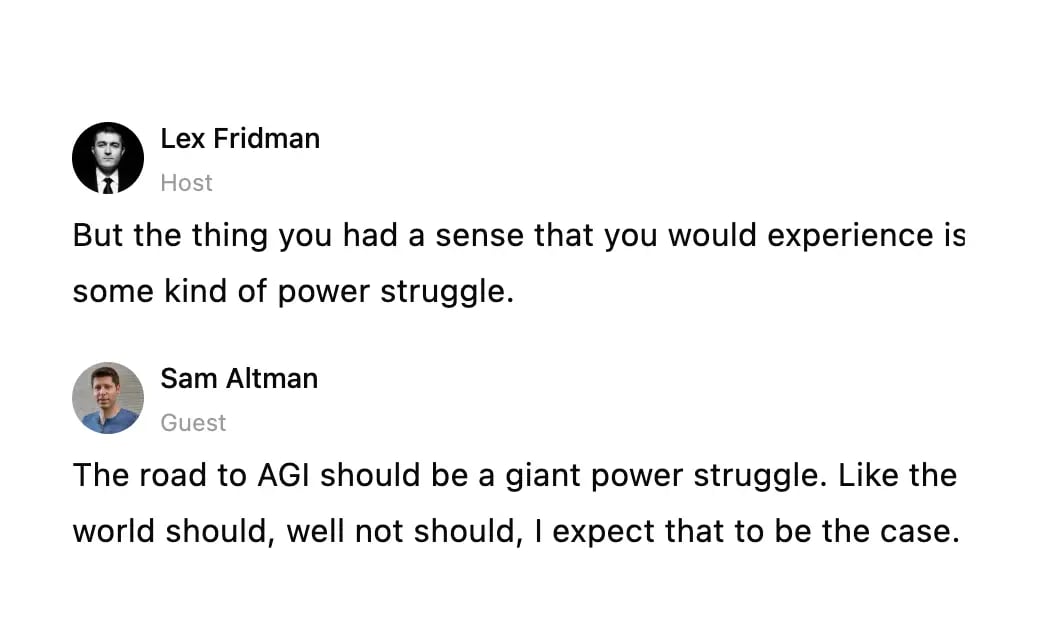
Speaker detection
Automatically identify different speakers in your recordings and label them with their names.
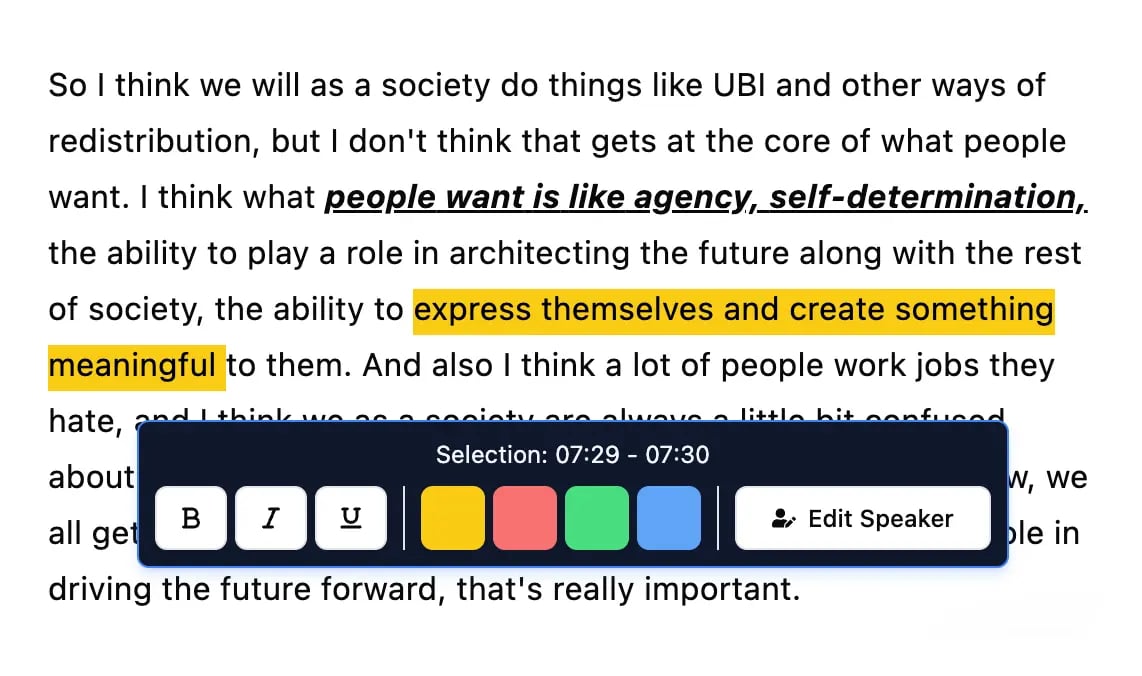
Editing tools
Edit transcripts with powerful tools including find & replace, speaker assignment, rich text formats, and highlighting.
This approach doesn't just save time and money. It builds a culture of collaboration where everyone—from the newest hire to the most seasoned expert—can tap into the team's combined genius.
Understanding Explicit vs. Tacit Knowledge
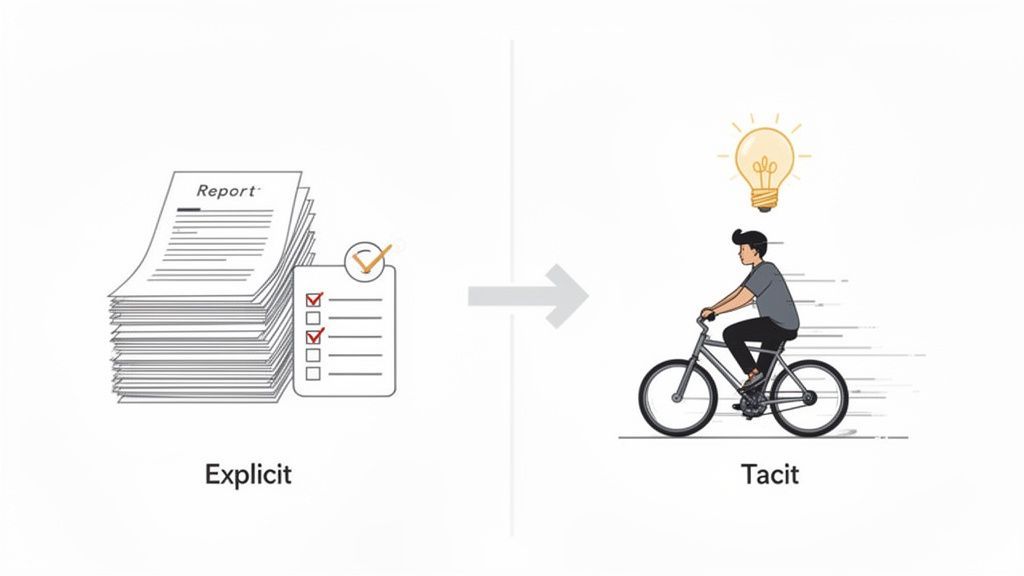
To build a powerhouse of shared intelligence, you first have to recognize that not all knowledge is created equal. Knowledge sharing in organizations boils down to managing two very different types: explicit and tacit. Getting a handle on the difference is the first real step toward making the most of both.
Think of explicit knowledge as anything you can write down, save to a database, or attach to an email. It’s the "what" of your organization—the structured, concrete information that’s easy to capture and pass around.
This includes things like:
- Company policies and official procedures
- Project plans, reports, and data sheets
- Step-by-step training guides and checklists
Explicit knowledge is straightforward. It’s the rulebook, the blueprint, the recipe. It's absolutely essential for keeping things running smoothly, but it only tells part of the story. The real magic—the stuff that gives you a competitive edge—often lies in what can't be written down so easily.
The Power of Tacit Knowledge
Now, let's talk about tacit knowledge. This is the "how" and the "why" that you won't find in any manual. It's the intuitive, experience-based wisdom people pick up over years of doing their jobs.
Think about learning to ride a bike. You can read a guide on balance and pedaling (explicit knowledge), but you only really learn by getting on and doing it—feeling the subtle shifts in your weight and developing an instinct for steering. That instinct? That's tacit knowledge.
In the workplace, this is the salesperson’s gut feeling about when to close a deal, the engineer’s knack for spotting a weird bug, or the manager’s ability to read a room. It’s the wisdom that lives in people’s heads, shaped by countless trials and errors. It’s usually shared through stories, mentorship, and casual conversations.
Tacit knowledge is the collection of experiences, insights, and intuitions that are difficult to express in writing but are critical for making expert decisions. Capturing it is the key to unlocking an organization's full potential.
Because it's so personal and tied to context, tacit knowledge is a nightmare to capture and scale. When a veteran employee walks out the door, they take decades of this invaluable wisdom with them, leaving a huge hole in the company's collective brain. This is why skills like learning what is active listening are so crucial for helping this knowledge move from one person to another.
Why Tacit Knowledge Is Your Biggest Risk
Most of a company’s competitive advantage lives in people’s heads, not documents. When this experience-based knowledge isn’t captured, it disappears through attrition, role changes, or time—forcing teams to relearn the same lessons repeatedly.
Building a Bridge Between Tacit and Explicit
The ultimate goal of modern knowledge sharing is to build a bridge between these two worlds. How can you turn those priceless, unspoken insights into assets everyone can access?
This is where capturing conversations becomes a game-changer. Every meeting, client call, and training session is overflowing with tacit knowledge. When you automatically transcribe those discussions and make them searchable, you transform them. A passing comment about a customer’s pain point becomes a searchable piece of market intelligence. An experienced leader's story about a past project becomes a permanent case study. This is similar to how companies are creating behind-the-scenes content to make their internal culture and operations more tangible for an external audience.
By turning the spoken word into text, you start the process of converting that elusive tacit wisdom into structured, explicit knowledge. This new asset can be searched, summarized, and shared, making sure your organization's most valuable insights don’t just walk out the door.
Proven Models for Sharing Knowledge in Your Organization
There’s no magic bullet for creating a great knowledge sharing system. The real secret is to pick and mix the right strategies that actually fit how your company works. Think of it less like finding a single solution and more like building a custom toolkit.
Different models solve different problems. A fast-paced sales team has different needs than a detail-oriented engineering department. The goal is to understand what each approach does best so you can build a flexible system that keeps information flowing where it needs to go.
What Effective Knowledge Sharing Unlocks
Faster Decision-Making
When past discussions, expert insights, and historical context are searchable, teams make confident decisions without second-guessing or delays.
Scalable Expertise
Expert knowledge stops being locked to individuals and becomes accessible to everyone, even as teams grow or change.
Reduced Rework
Teams avoid repeating mistakes or re-solving problems by learning directly from past conversations and outcomes.
Stronger Collaboration
Shared understanding breaks down silos, helping teams align faster and work toward common goals.
Let’s break down four of the most effective models that companies use to turn what individuals know into a powerful company-wide asset.
Foster Communities of Practice
A Community of Practice (CoP) is just a fancy term for a group of people who are passionate about the same thing and get together to help each other get better. These aren't formal teams assigned by a manager; they pop up organically because people want to learn from each other. It’s where your experts voluntarily trade tips, troubleshoot tough problems, and come up with new ideas.
Imagine a handful of your software developers getting hooked on a new programming language. They might start a weekly meetup to share code snippets, talk through roadblocks, and show off new tricks. That kind of peer-to-peer learning is often way faster and more effective than any formal training course.
These communities are gold because they’re built to transfer tacit knowledge—all the unwritten rules, instincts, and "how-to" wisdom that you can't just write down in a manual.
Implement Mentorship and Coaching Programs
While communities are great for group learning, mentorship is all about that direct, one-on-one knowledge transfer. A good mentorship program pairs your seasoned pros with newer folks, creating a dedicated channel for passing down hard-won wisdom. It's one of the best ways to keep deep institutional knowledge from walking out the door.
Think about a new marketing manager just starting out. A senior mentor can teach them about campaign strategy, sure, but they can also give them the inside scoop on navigating company politics or building relationships with key leaders. That’s the kind of stuff that shortens the learning curve from years to months.
Mentorship isn't a one-way street. The mentee gets priceless guidance, but the mentor also sharpens their own leadership skills and gets a fresh perspective. It creates a powerful cycle of learning and growth across the entire company.
These programs are especially useful for onboarding new hires and developing future leaders, making sure the important stuff—both skills and culture—gets passed down to the next generation.
Build a Centralized Wiki
For all the stuff that can be written down—the facts, processes, and official procedures—you absolutely need a centralized wiki or knowledge base. This is about creating a single source of truth so people aren't digging through shared drives, old email threads, and random Google Docs to find what they need.
A well-kept wiki becomes your company’s collective brain. It’s the one place everyone goes to find:
- Standard Operating Procedures (SOPs) for doing things the right way, every time.
- Company Policies that everyone needs to know.
- Project Documentation to keep teams on the same page.
- Technical Guides and troubleshooting tips for your products or internal tools.
For example, your customer support team can pull approved answers from the wiki, guaranteeing every customer gets the same accurate information. The trick is making it dead simple for people to add and update information.
Leverage Social Learning Platforms
Finally, don't underestimate the power of social learning. Tools like Slack or Microsoft Teams bring the fast, informal vibe of social media into the workplace. This approach is all about spontaneous questions and public conversations.
When someone asks a question in a public channel instead of a private DM, the answer suddenly becomes a resource for everyone. The next person with that same question can just search for it instead of interrupting someone else's work. You organically build a searchable FAQ that tackles your company's real-world challenges.
This informal model of knowledge sharing in organizations is fantastic for quick problem-solving and making open collaboration the default.
How to Overcome Common Barriers to Collaboration
Even when you have the perfect systems in place, getting people to consistently share what they know can be the hardest part of building a collaborative culture. Let’s be honest, changing mindsets is a lot tougher than rolling out new software. The biggest hurdles aren’t technical; they’re deeply human.
So, let's break down the three biggest barriers that stop knowledge from flowing freely and talk about practical, people-focused ways to tear them down. True knowledge sharing in organizations only happens when you tackle these root causes head-on.
Confronting Cultural Hurdles
The most stubborn barrier is often a deeply ingrained mindset: "knowledge is power." In competitive workplaces, experts can feel that sharing their unique insights will make them less valuable or even threaten their job security. This creates information silos where critical knowledge is hoarded, not shared.
When people view their expertise as personal currency, they become gatekeepers. The answer isn't to force them to open up, but to completely change the cultural math.
You have to start celebrating and rewarding the sharers. This can look like:
- Public Recognition: Give a shout-out to top contributors in company-wide meetings or newsletters.
- Performance Reviews: Make knowledge sharing an actual metric in performance evaluations.
- Leadership Modeling: When leaders openly ask questions and share what they're learning, it sends a powerful message that collaboration is a core company value.
By rewarding the act of sharing, you redefine power. It's no longer about hoarding knowledge; it's about amplifying it for the good of the whole team.
Simplifying Technological Frustration
Nothing kills the impulse to share faster than clunky, confusing software. If someone has to log into three different systems, fight a terrible user interface, and manually tag an entry just to document a simple process... they just won't do it. Technology should remove friction, not add to it.
This is a massive problem. While cloud tools have been great for remote teams, they’ve also created a mess. According to KMWorld, a staggering 36% of companies use three or more knowledge management tools, and 31% don't even know how many they have. This creates a fragmented, inconsistent experience that actively discourages people from participating.
The best knowledge sharing tool is the one people actually use. If it doesn’t fit seamlessly into their daily workflow, it’s just another forgotten login.
The key is to meet your employees where they already work. Look for platforms that integrate directly with the communication hubs they live in, like Slack or Microsoft Teams. The goal is to make sharing feel like a natural part of their job, not another chore to add to the to-do list.
Overcoming Procedural Roadblocks
The final barrier is all about process—or the lack of it. People are busy. Without a clear mandate and dedicated time, documenting what they know feels like a low-priority task that can always be pushed to tomorrow.
"I'm too busy" isn't just an excuse; it's often a legitimate complaint. When knowledge sharing feels like an "extra" task, it's always the first thing to get dropped when a deadline is breathing down your neck.
To truly break down silos, you need to embed sharing into your company's DNA. Consider concrete strategies to improve team collaboration by building it right into your operations. Here are a few ideas:
- Allocate Time: Make space for it. Dedicate specific blocks of time, like "Documentation Fridays," or build documentation milestones directly into your project plans.
- Create Clear Incentives: Go beyond a simple thank you. Offer small bonuses, extra vacation days, or professional development opportunities for your top knowledge contributors.
- Establish Ownership: Assign "knowledge owners" for specific topics. This ensures information stays current and turns maintenance into a shared, manageable responsibility.
By tackling these cultural, technological, and procedural barriers head-on, you can create an environment where sharing knowledge becomes the easy, default, and rewarding choice for everyone on your team.
Using AI to Make Unspoken Knowledge Searchable
This is where theory hits the real world. The whole idea of capturing that hard-to-pin-down "tacit knowledge" stops being an abstract business school concept and becomes something you can actually do with the right tech. Specifically, with AI-powered transcription platforms.
Think about your last project post-mortem on Zoom. It was probably a goldmine. People shared what really worked, what was a quiet disaster, and all the little gut-feel insights that would never, ever make it into a formal report. Normally, as soon as that call ends, all of that valuable perspective vanishes into thin air, locked away in the memories of the few people who were there.
From Lost Conversations to a Searchable Library
AI tools completely flip that script. A platform like Transcript.LOL can grab that hour-long Zoom recording and automatically transcribe the entire conversation in minutes. But it’s not just a wall of text. It’s smart enough to identify who said what, turning a temporary chat into a permanent, structured document.
That transcript is now the foundation for a powerful knowledge engine.
Turning Transcripts into Usable Knowledge

Import from multiple sources
Import audio and video files from various sources including direct upload, Google Drive, Dropbox, URLs, Zoom, and more.
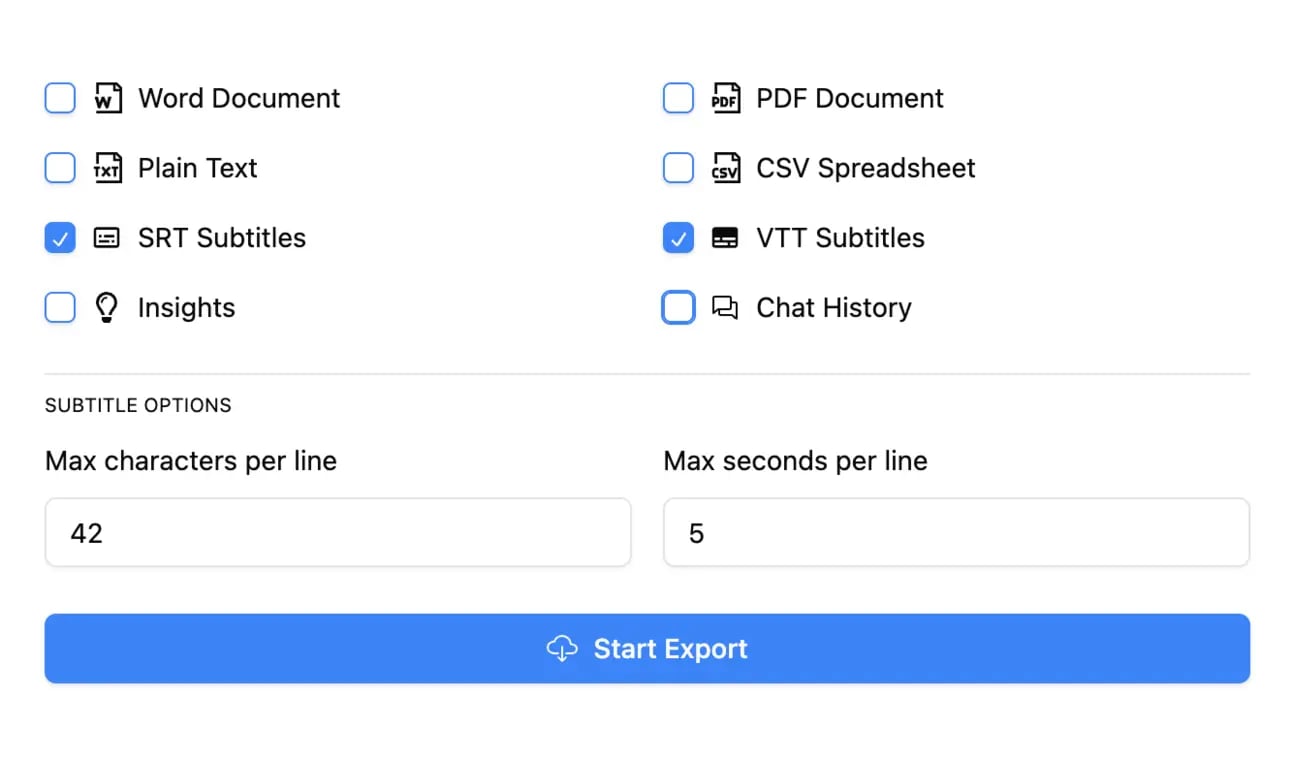
Export in multiple formats
Export your transcripts in multiple formats including TXT, DOCX, PDF, SRT, and VTT with customizable formatting options.
Summaries and Chatbot
Generate summaries & other insights from your transcript, reusable custom prompts and chatbot for your content.
Suddenly, every idea, every off-the-cuff suggestion, and every hard-won lesson is indexed and ready to be found. A junior developer trying to solve a problem can search for a specific technical term and jump straight to the moment a senior engineer explained it. A product manager can search a client's name and find raw, unfiltered feedback shared during a call.
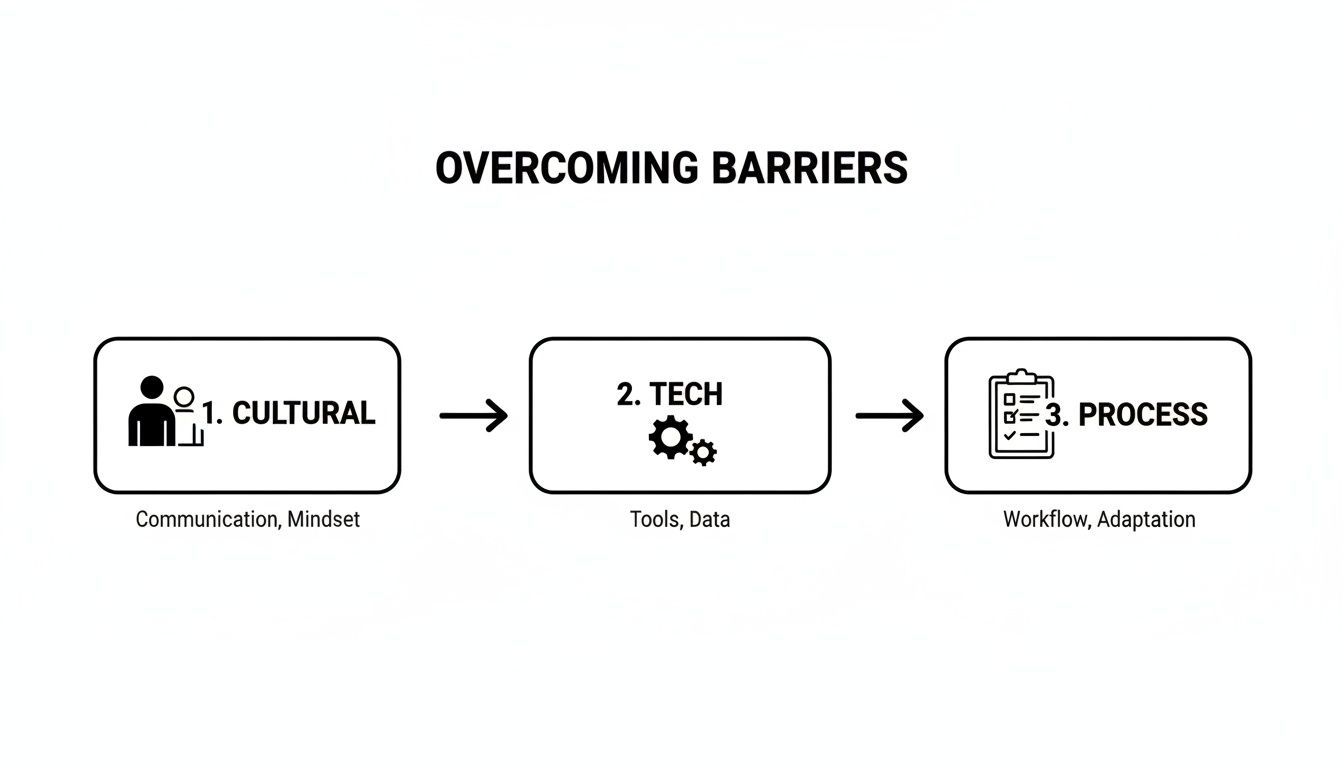
The key is to tackle these cultural, tech, and process roadblocks in order. By doing so, organizations can build a framework for collaboration that actually sticks.
Unlocking Deeper Insights with AI Analysis
But just turning speech into text is only the first step. The real magic happens next. Modern AI doesn’t just transcribe; it analyzes the content to pull out different kinds of value for different people in your organization.
From Records to Intelligence
AI-driven analysis transforms raw transcripts into summaries, action items, and structured insights—turning passive records into active organizational intelligence.
From a single meeting transcript, you can automatically get:
- A Concise Summary: Perfect for executives who need the high-level takeaways without sitting through the whole discussion.
- Action Items: The AI flags all the tasks assigned during the meeting, noting who is responsible. Instant accountability for project managers.
- A Mind Map: For visual thinkers, the system can map out the core concepts and how they relate, making a complex conversation easy to grasp at a glance.
This automated process turns every conversation into a multi-format asset. It ensures the value is accessible to everyone, no matter their role or how they prefer to learn. This is a big reason why the global knowledge management market was valued at US$773.6 billion in 2024 and is expected to rocket to US$3,562.8 billion by 2034. According to Fact.MR, these systems are what allow employees to find what they need in seconds.
By transforming spoken words into structured data, you’re not just archiving conversations. You're building a central intelligence hub from the actual things your teams say every day, making your organization's collective wisdom active and accessible.
Building Your Organization's Collective Brain
Tools built for this specialize in creating a reliable and intelligent knowledge base. For example, you can add a custom vocabulary to teach the AI your company’s specific jargon, acronyms, or client names. This dramatically improves transcription accuracy and ensures your organization's unique language is captured perfectly.
Powerful search then lets anyone query this entire repository of conversations. Instead of asking around, "Who knows about the Q4 marketing campaign?" they can just search the term and find every single meeting where it was discussed. This is how you make tacit knowledge discoverable on-demand.
Using an AI meeting assistant doesn't just record what was said—it ensures those insights are never lost again, turning your team's collective voice into your most valuable, reusable asset.
A Practical Framework for Implementation
A great plan is one thing, but action is what really sparks a cultural shift. Building an effective system for knowledge sharing in organizations can feel like trying to boil the ocean, but it doesn’t have to. The secret is to break the process down into manageable phases that build momentum and show real value every step of the way.
This framework gives you a clear roadmap to get started. The goal isn't an overnight transformation but a series of focused, intentional steps that lay a strong foundation for a more connected and collaborative future.
Secure Leadership Buy In
Before you write a single wiki page or demo any software, you have to get your leadership team on board. This is, without a doubt, the most critical step. Don't just ask for permission; build a solid business case that connects your plan directly to what the company is trying to achieve.
Frame it in terms of outcomes they actually care about: onboarding new hires faster, cutting down project delays, sparking more innovation, or simply making better decisions. If you have data, use it. Show them the real costs of information silos and the potential ROI of a workforce that’s truly connected. When leaders become champions of knowledge sharing, it sends a powerful signal to everyone that this is a real priority, not just another passing fad.
Start Small with a Pilot Program
Instead of trying to launch this for the entire company all at once, just start small. Pick one department or a single cross-functional team that seems open to new ideas and is dealing with problems that better knowledge sharing could genuinely solve.
Running a pilot program lets you test your approach in a controlled, low-risk environment. You can iron out the wrinkles, collect honest feedback, and, most importantly, create a success story. A win in the engineering department, for example, becomes a powerful case study you can use to get other, more skeptical teams excited. It's about proving the concept and letting momentum build organically from the ground up.
Select the Right Technology Stack
Once you have a pilot plan, you can start picking the tools that will actually support your goals. The absolute key here is to put user experience above everything else. If a tool is clunky or feels disconnected from how people already work, they just won't use it. End of story.
Look for solutions that:
- Integrate Seamlessly: Your tools should play nicely with the platforms your team lives in every day, whether that's Slack, Microsoft Teams, or your project management software.
- Automate Capture: Platforms that can automatically transcribe meetings and calls lift a huge manual burden off your employees, making it almost effortless to build your knowledge base. If you need some ideas, check out our guide on creating useful meeting minutes with action items samples.
- Offer Powerful Search: The ability to find what you're looking for, fast, is non-negotiable.
Establish Clear Governance
A knowledge sharing system without any rules will quickly turn into a messy, untrustworthy digital attic full of outdated junk. Governance isn't about creating red tape; it's about setting clear and simple expectations for how information gets created, updated, and eventually archived.
Governance is the simple set of rules that ensures your shared knowledge remains valuable. It defines who is responsible for what, keeping your information accurate, relevant, and easy to navigate.
Assign "knowledge owners" for specific topics and create an easy way for anyone to flag content that's out of date. This sense of shared responsibility is what keeps the whole system healthy and reliable for everyone.
Measure What Matters
Finally, you need to track your progress. Pick a few key metrics that tie directly back to the business case you made to leadership at the very beginning. This closes the loop and proves that all this effort is actually paying off.
You could measure things like:
- A reduction in the time it takes to onboard new hires.
- Fewer of the same questions being asked over and over in public channels.
- An increase in traffic and usage of your central knowledge base.
By tracking these kinds of metrics, you can show tangible success, justify further investment, and build the case for expanding your knowledge sharing in organizations initiative.
Got Questions? We've Got Answers
Shifting to a more open, collaborative culture always brings up a few good questions. Let's tackle some of the most common ones that pop up when you start building a real knowledge-sharing practice.
How Do We Get People to Actually Participate?
You can’t just buy a tool and expect magic. Real participation comes down to a mix of culture, convenience, and clear wins for the team.
It all starts at the top. Leadership has to walk the walk—actively sharing, asking questions in public channels, and treating knowledge sharing as a core company value, not just another policy to ignore.
Next, it has to be dead simple. If sharing information feels like extra work or means logging into some clunky, forgotten system, people just won't do it. The path of least resistance has to be the path of sharing. Finally, give people a reason. This doesn't have to be cash bonuses. Public shout-outs for helpful contributors or tying participation to performance reviews can work wonders.
What’s the Best Way to Measure the ROI?
Figuring out the return on your investment means looking at both the hard numbers and the softer, but equally important, benefits.
The easy stuff to track is the direct, quantitative wins.
- Direct ROI: Keep an eye on reduced time people spend hunting for information. Track how much faster new hires get up to speed or how many fewer repeat questions pop up in support channels. These are real efficiency gains you can put a number on.
- Indirect ROI: But don’t stop there. Look at the qualitative metrics, too. Are people happier? Are you seeing more innovative ideas spark from cross-team chats? Are decisions being made faster because the right info is easy to find?
Start by picking a few key metrics that tie directly back to your biggest business goals. That’s how you prove the value.
How Do We Stop Our Knowledge Base From Becoming a Mess?
Keeping your shared information accurate and trustworthy doesn't require a complex bureaucracy. It just needs a simple, straightforward governance plan that makes maintenance a shared, manageable responsibility.
A simple governance plan prevents your knowledge base from becoming a digital junkyard. It assigns ownership and empowers everyone to help keep information trustworthy and relevant.
Assign "knowledge owners" for different topics—these are the go-to experts responsible for giving their content a quick review every so often. On top of that, build in a simple way for anyone on the team to flag info that looks outdated or incorrect.
And for knowledge captured automatically, like from meeting transcripts, the context is already baked in. The date and list of attendees are part of the record, making its historical accuracy perfectly clear.
Unlock the tacit knowledge hidden in your team's conversations. Transcript.LOL uses AI to automatically transcribe meetings, interviews, and calls, transforming them into a searchable, shareable, and actionable company asset. Start turning your discussions into a powerful knowledge base today.