What's a Transcription Turning Speech into Text
Curious about what's a transcription? Our guide explains how turning speech into text works, from AI vs human methods to choosing the right service.
Praveen
April 2, 2025
So, what exactly is transcription?
Ever wondered how a podcast episode magically turns into a blog post? Or how you can search for a specific quote inside a two-hour-long meeting recording? That’s transcription at work.
At its simplest, transcription is the process of converting spoken words from an audio or video file into written text. Think of it as a bridge between sound and the written word, turning something you can only listen to into a format you can read, search, and share.
Features That Enable Transcription
State-of-the-art AI
Powered by OpenAI's Whisper for industry-leading accuracy. Support for custom vocabularies, up to 10 hours long files, and ultra fast results.

Import from multiple sources
Import audio and video files from various sources including direct upload, Google Drive, Dropbox, URLs, Zoom, and more.
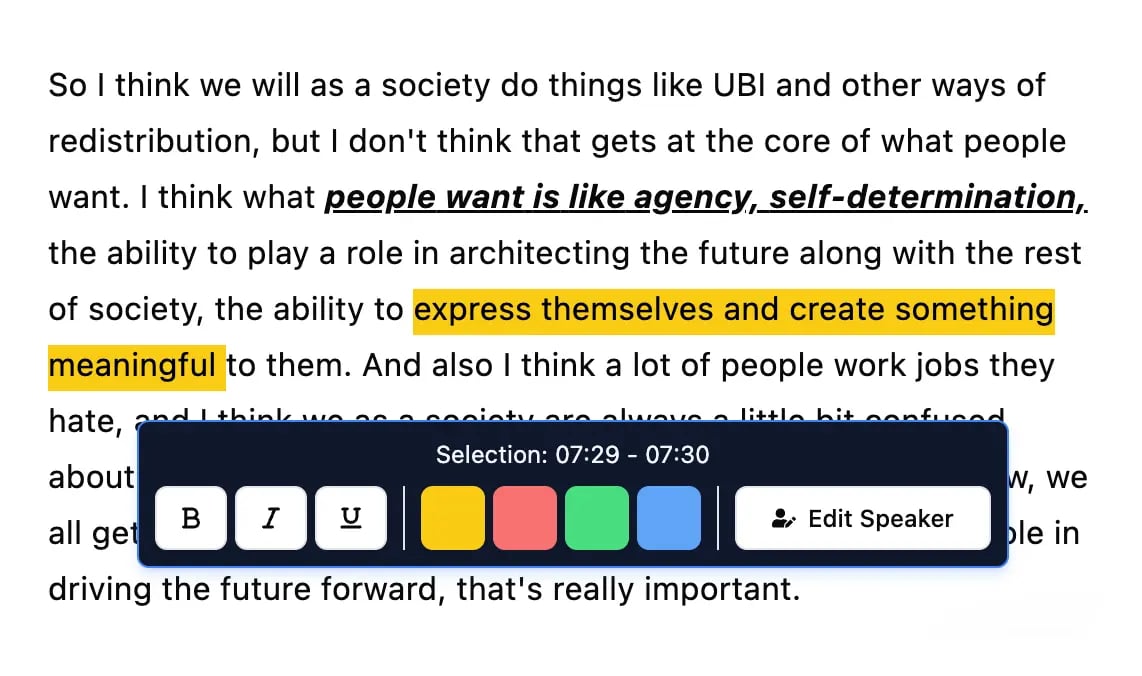
Editing tools
Edit transcripts with powerful tools including find & replace, speaker assignment, rich text formats, and highlighting.
Unlocking Your Audio and Video Content
Without transcription, your audio and video files are essentially locked boxes. The valuable information is all in there, but you can't easily get to it, search through it, or do much else with it. It’s like having a book with all the pages glued shut.
Once you convert that dialogue into text, everything changes. Every single word becomes discoverable and useful.
Why Transcription Unlocks Hidden Value?
Transcription transforms passive audio into active information. It enables searching, quoting, and reuse across formats. This shift turns recordings into long-term knowledge assets.
This is a game-changer for a few key reasons:
- Accessibility: Transcripts open up your content to people who are deaf or hard of hearing. They also make it much easier for non-native speakers to follow along.
- Searchability: Need to find that one specific quote from an hour-long interview? Instead of scrubbing through the timeline, you can just hit CTRL+F and find it in seconds.
- Repurposing: This is where the magic really happens. A single webinar recording can be sliced and diced into a dozen blog posts, a handful of social media clips, and a detailed how-to guide. You get so much more mileage out of every piece of content you create.
From Manual Labor to AI Power
It wasn't always this easy. For decades, transcription was a painstaking manual job done by highly skilled typists, mostly in the legal and medical fields. This manual effort built an industry already worth over $21 billion by 2022. But as podcasts, online meetings, and virtual courses exploded in popularity, the demand for a faster, more affordable solution skyrocketed.
Today, AI-powered platforms have made transcription practically instantaneous. What used to be a specialized, expensive service is now an essential tool for everyone from students and content creators to large corporate teams.
AI Has Changed Transcription Forever
What once took days now takes minutes. AI transcription delivers fast, affordable, and scalable results — making professional transcription accessible to everyone.
This massive shift is why the global transcription market is now worth an estimated $23.8 billion in 2024. It shows just how vital transcription has become for making sense of the mountains of audio and video we all create. You can dive deeper into the growing transcription market on Sonix.ai.
To give you a clearer picture, let's break down the key pieces of modern transcription.
Core Components of Modern Transcription
| Component | What It Does | Why It's Important |
|---|---|---|
| Audio/Video Input | Accepts various media files (MP3, MP4, WAV, etc.) for processing. | Provides the flexibility to work with content from any source—a Zoom call, a podcast, or a video interview. |
| Speech-to-Text (STT) Engine | Uses AI and machine learning to convert spoken words into a raw text file. | This is the engine that does the heavy lifting, turning hours of audio into text in just minutes. |
| Speaker Identification | Distinguishes between different people speaking and labels their dialogue accordingly. | Makes conversations easy to follow and is essential for interviews, meetings, and panel discussions. |
| Timestamping | Aligns the written text with the exact time it was spoken in the audio or video file. | Allows you to click on any word in the transcript and instantly jump to that point in the media. |
| Interactive Editor | A user-friendly interface for reviewing and correcting the AI-generated transcript. | No AI is perfect. An editor gives you the final say, ensuring the text is 100% accurate and polished. |
| Export Options | Allows you to download the final transcript in various formats (TXT, DOCX, SRT). | Ensures you can use your transcript wherever you need it—in a blog post, as video captions, or in a report. |
These components work together to create a seamless experience, turning a once-difficult task into a simple, everyday workflow.
How Transcripts Are Actually Created
So, how does a spoken conversation become a written document? It really comes down to two very different paths, each with its own pros and cons.
You can think of it like the difference between a custom-tailored suit and one you buy off the rack. Both get the job done, but the process, precision, and price are in completely different leagues.
The Human Touch: Traditional Transcription
The old-school method involves a real person—a trained professional—listening intently to an audio file and typing everything out by hand. It's a meticulous process that requires a sharp ear for nuance, the ability to distinguish between multiple speakers, and the skill to decipher tricky audio with background noise or heavy accents.
This human-first approach is fantastic for capturing context, emotion, and those subtle expressions that an algorithm might miss entirely. The trade-off? This level of detail comes at a cost. It’s significantly slower and much more expensive, often taking several hours of work for just one hour of audio.
The Rise of AI Transcription
Today, transcription is much more than just manual labor. AI-powered platforms have completely changed the game, and the market reflects that shift. Valued at $4.5 billion in 2024, the global AI transcription market is on track to hit a staggering $19.2 billion by 2034. This explosive growth is fueled by AI's ability to deliver transcripts with over 90% accuracy on clear audio, often in just a few minutes.
This simple, three-step process is what makes it all possible.
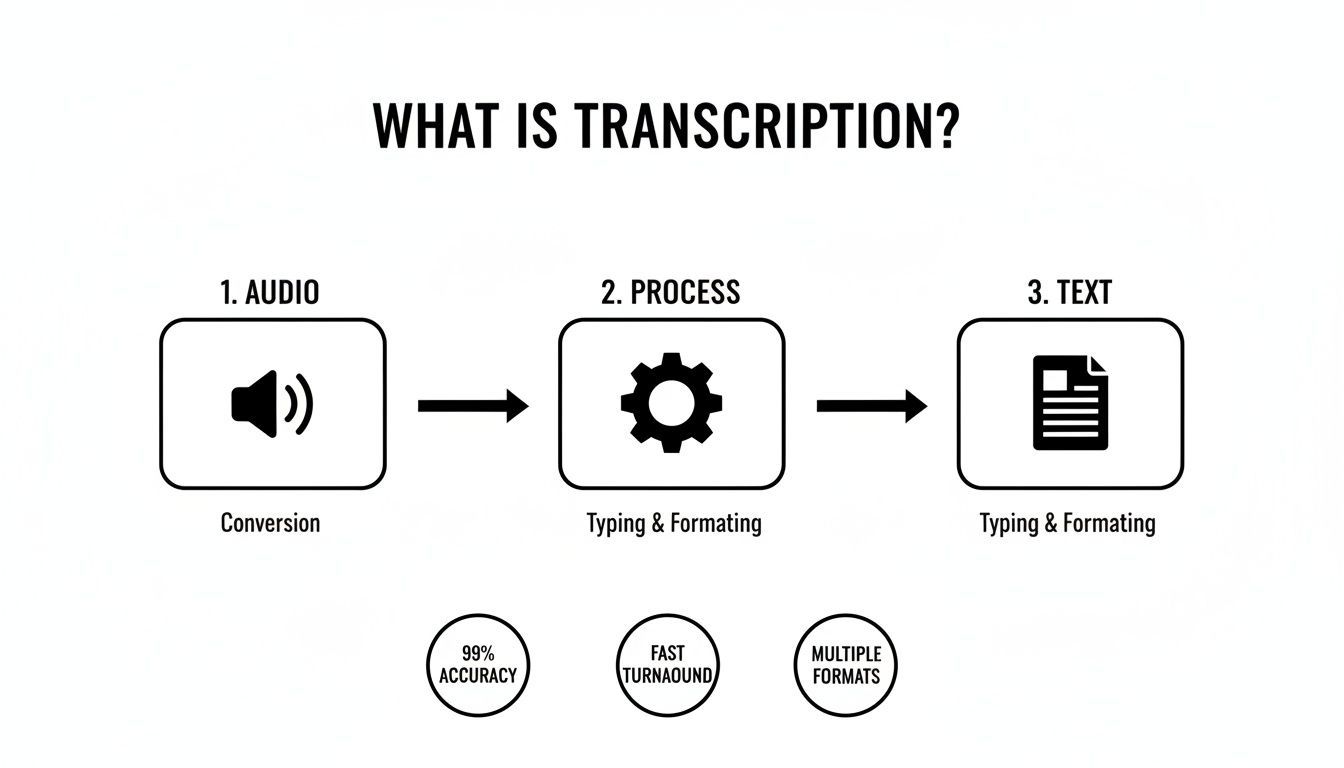
As you can see, AI takes raw audio and turns it into structured, useful text almost instantly. This rapid turnaround is the real game-changer. Instead of waiting days for a human transcriber, you can get a draft ready for review in minutes. If you're curious about the mechanics behind this, our guide on how audio to text AI works breaks it down even further.
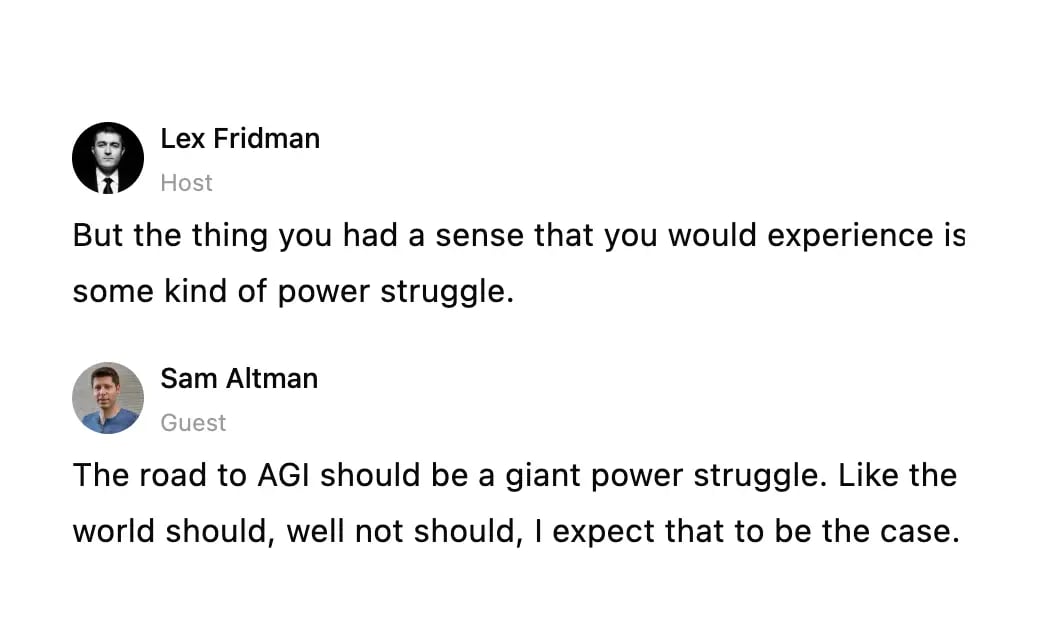
Speaker detection
Automatically identify different speakers in your recordings and label them with their names.
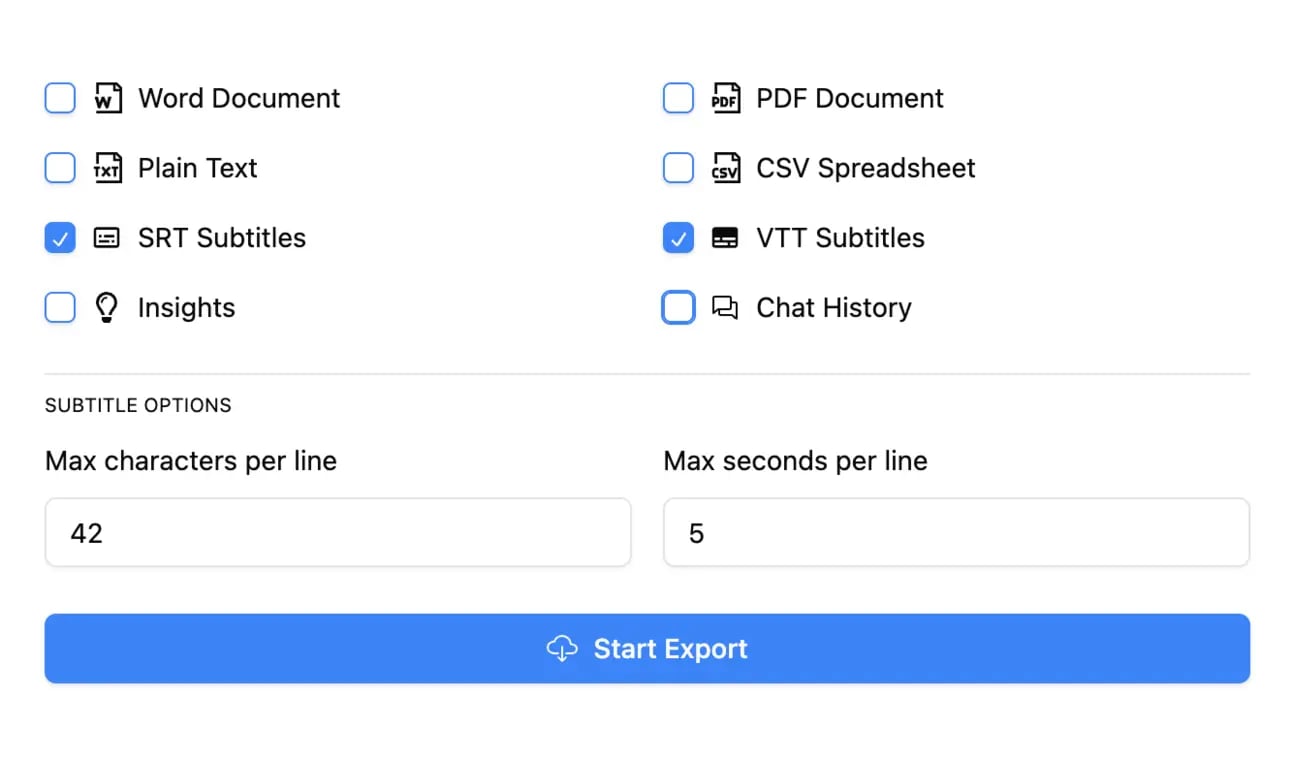
Export in multiple formats
Export your transcripts in multiple formats including TXT, DOCX, PDF, SRT, and VTT with customizable formatting options.
Summaries and Chatbot
Generate summaries & other insights from your transcript, reusable custom prompts and chatbot for your content.
Human Transcription vs AI Transcription
To make the choice clearer, let's put them side-by-side. Here’s a quick comparison to help you decide which method is the right fit for your needs.
| Feature | Human Transcription | AI Transcription |
|---|---|---|
| Accuracy | Up to 99%+, excels with complex audio | 90-95% on clear audio, struggles with noise & accents |
| Speed | Slow; hours or days for one hour of audio | Extremely fast; minutes for one hour of audio |
| Cost | High; typically priced per audio minute | Low; affordable subscription or pay-as-you-go models |
| Context/Nuance | Excellent at capturing emotion and speaker intent | Struggles to interpret non-verbal cues and context |
| Speaker ID | Highly accurate, done manually | Automated, but can make mistakes with similar voices |
| Scalability | Limited by human availability | Highly scalable; can process thousands of files at once |
Ultimately, the "best" method really depends on your project. If you need a flawless, legally-binding transcript of a chaotic courtroom proceeding, a human is probably your best bet. But for most everyday tasks—like transcribing meetings, interviews, or lectures—AI offers an incredible combination of speed, affordability, and "good enough" accuracy that's hard to beat.
Digging Into the Different Types of Transcripts
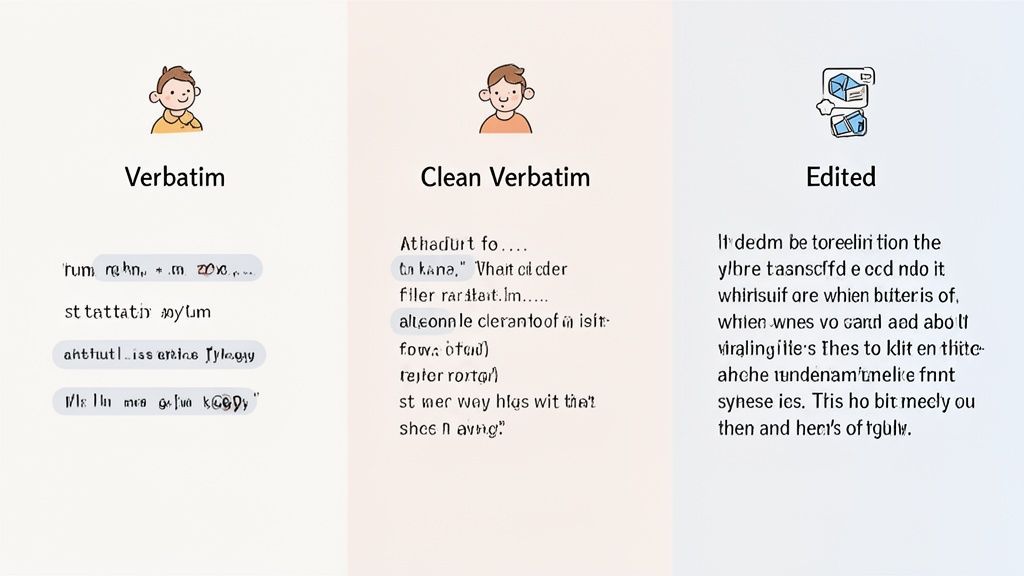
So, you know what a transcript is. But here’s the thing: not all transcripts are created equal. The final text can look wildly different depending on what you need it for, and picking the right style from the get-go is key to getting something you can actually use.
Think of it like editing a photo. Sometimes you want the raw, unfiltered shot that captures every single detail, flaws and all. Other times, you need that polished, magazine-ready version. Transcripts work the same way and generally fall into one of three buckets.
- Verbatim: This is the most literal, word-for-word style you can get. It captures absolutely everything—every "um," "uh," stutter, false start, and even non-verbal sounds like laughter or a long pause. This level of detail is critical for legal cases or in-depth research where every single utterance carries weight.
- Clean Verbatim: This is the go-to style for most people. It’s lightly edited to improve readability by removing all the filler words, stutters, and unintentional repetitions. The speaker’s original phrasing stays intact, but the fluff is gone, making it perfect for interviews, podcasts, and meeting notes.
- Edited: This transcript takes it a step further, polishing the text for publication. Sentences might be restructured for better flow, grammar is perfected, and the whole thing is refined to read like a well-written article. This is what you want when turning a recording into a blog post or a formal report.
How to Choose Your Transcript Style
Let’s say you’re transcribing a live Q&A session. A verbatim transcript would be a mess of interruptions and filler words, making it tough to follow. A clean verbatim version, on the other hand, gives you a crisp, accurate record of the actual conversation. Our guide on how to properly transcribe an interview dives deeper into these practical choices.
The key is to match the transcript style to your end goal. For legal accuracy, choose verbatim. For clear, readable content from spoken audio, clean verbatim is the standard. For polished, publishable text, an edited transcript is the way to go.
Who Uses Transcription and Why It Matters
Okay, let's move past the technical stuff. The real "aha!" moment with transcription comes when you see who's actually using it and the problems it solves day in and day out. This isn't some niche tool for a handful of professions; it's become a cornerstone for turning spoken words into a tangible, powerful asset across countless industries.
Take podcasters and journalists, for instance. A transcript is their workflow's foundation. It lets them effortlessly pull quotes for articles, whip up detailed show notes, and make hours of interviews instantly searchable. Try finding one specific soundbite in a two-hour recording without one. It’s a nightmare.
Driving Content and Business Strategy
The corporate world is no different. Smart marketers are turning a single webinar into a whole library of content—SEO-rich blog posts, social media snippets, and email campaigns—all from the transcript. It’s also a huge asset for anyone involved in strategic content creation, making it simple to repurpose audio and video into any text format you can imagine.
Inside the company, teams are transcribing meetings to create a flawless, searchable record of every decision and action item. It’s the ultimate way to make sure nothing important slips through the cracks.
Transcription unlocks the hidden value in your audio and video files. It makes content accessible, searchable, and infinitely reusable, providing a significant return on investment for any creator or business.
What Transcription Enables Across Industries
Content Repurposing
Turn one recording into blogs, social posts, guides, and captions—without re-recording.
Faster Research
Search, analyze, and quote interviews or discussions instantly using text.
Team Alignment
Keep a clear, searchable record of meetings, decisions, and action items.
Inclusive Access
Make content usable for deaf users, non-native speakers, and global teams.
This sheer utility has fueled massive growth in specialized fields. Just look at healthcare. The medical transcription software market alone was worth a staggering USD 2.55 billion in 2024 and is on track to hit USD 8.41 billion by 2032. As businesses go global, the demand for multilingual transcription is also exploding, with that market projected to reach USD 6.0 billion by 2035. The need for clear, accessible communication is driving this growth everywhere.
Essential Applications Across a Variety of Roles
The use cases are incredibly diverse, with each one solving a very specific headache:
- Educators and Students: They're recording lectures to create searchable study guides, making learning more accessible for everyone.
- Legal Professionals: Paralegals and attorneys depend on perfect transcripts of depositions and hearings to build their cases.
- Researchers: Qualitative researchers turn interview recordings into text to analyze themes, spot patterns, and pull direct quotes.
In every single one of these scenarios, transcription does the same fundamental job: it takes spoken information and makes it concrete, searchable, and incredibly useful.
What Affects Transcription Accuracy?
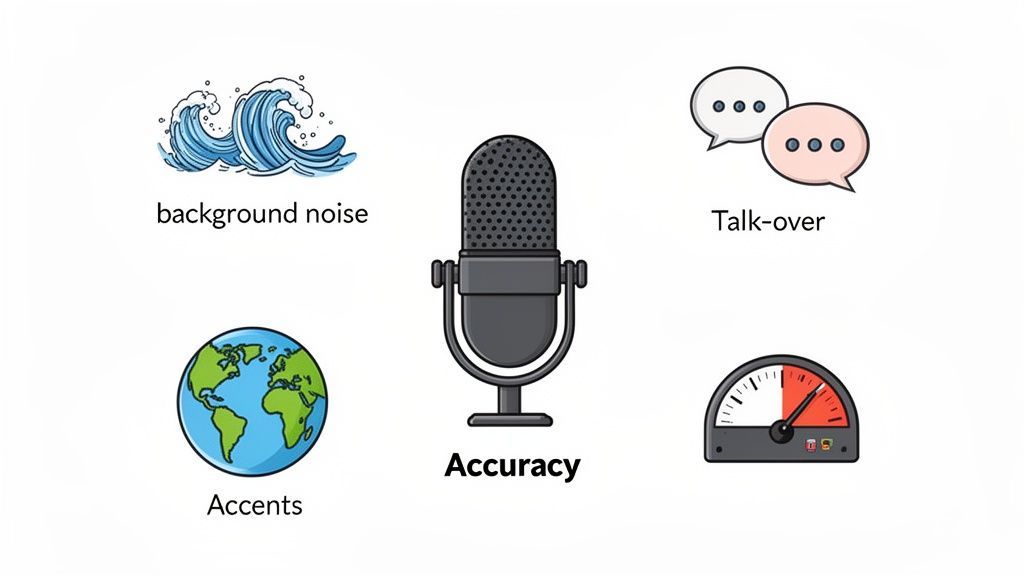 Accuracy is the backbone of a useful transcript, but getting a perfect result isn't always a given. Several key factors can dramatically influence the quality of an AI-generated text, and knowing what they are helps set realistic expectations for what you'll get back.
Accuracy Depends on Audio Quality
Poor audio, overlapping speech, and background noise reduce accuracy. Even the best AI benefits from clean recordings and a final human review.
The single most important variable is audio quality. A clean, crisp recording from a well-placed microphone will almost always yield a highly accurate transcript. On the flip side, files with background noise, distant speakers, or bad acoustics present a major challenge for any transcription engine.
Overlapping conversations are another common hurdle. When multiple people talk over each other, AI systems struggle to untangle the dialogue, leading to jumbled or incomplete sentences. This is why a structured interview is far easier to transcribe than a chaotic group brainstorm.
Fine-Tuning for Precision
Beyond the recording environment, the speech itself plays a huge part. Accents, speaking speed, and unique terminology can all throw off the final output. Think about it: a fast talker with a thick regional accent is much harder for an AI to understand than someone speaking clearly and deliberately.
Fortunately, you have some control here, even with challenging audio:
- Custom Vocabulary: This is a powerful feature that lets you "teach" the AI specific names, company acronyms, or industry jargon. By adding these terms to a custom dictionary, you massively reduce the odds of them being misinterpreted.
- Speaker Separation: When each speaker is distinct, the AI can assign dialogue correctly. Using separate microphones for each person in a multi-speaker recording is an excellent way to guarantee this.
Ultimately, even the best AI transcription might need a final human touch. A quick review can elevate a 95% accurate transcript to a perfect one, ensuring it's ready for professional use.
Even with these tools, a quick once-over is always a good idea. To learn more about this final polish, you can explore the essentials of proofreading in transcription in our detailed guide. It’s the last step to making sure every detail is spot on.
Choosing the Right Transcription Service
Alright, you've got your audio, and you know you need a transcript. Now comes the big decision: which service do you trust to turn that recording into a genuinely useful asset? With so many options out there, it's easy to get overwhelmed.
The trick is to cut through the noise and focus on what actually matters for your specific needs, budget, and workflow.
First things first, let's talk about the two biggest factors: accuracy and turnaround time. While a human service might eke out a slightly higher accuracy score on really tricky audio, modern AI platforms can deliver transcripts that are over 95% accurate in a matter of minutes. For most people, the blend of near-instant delivery and rock-solid accuracy from an AI tool is the clear winner.
From there, you want to look at how the platform fits into your day-to-day. Does it play nice with the file formats you use? Can you just drop in a YouTube link, or connect it to your cloud storage, instead of manually uploading everything? The best tools are the ones that feel like they’re working with you, not against you.
Evaluating Key Features and Policies
Once you've nailed the basics, a few make-or-break features separate the good services from the great ones. These are the details that ensure you have a smooth, secure experience from start to finish.
- Speaker Identification: If you’re transcribing interviews, meetings, or anything with more than one person, this is an absolute must-have. Automatic speaker labeling (sometimes called diarization) saves you the soul-crushing task of figuring out who said what.
- Integrations: A platform that connects with tools you already use—like Zapier, Google Drive, or Slack—is a game-changer. It lets you automate the boring parts of your workflow so you can focus on more important things.
- Security and Privacy: This one is non-negotiable. Always, always choose a provider with a strict "no-training" policy for user data. This is your guarantee that your confidential conversations and private content stay that way—private. They should never be used to train their AI models.
Your content is your intellectual property, period. A transcription service's privacy policy should be crystal clear that your data will never be touched or used for anything other than creating your transcript.
Ultimately, the best service is the one that lines up with what you're trying to accomplish. Understanding the different factors that determine transcription services cost will also help you find that sweet spot between powerful features and a price that makes sense.
By keeping these key points in mind, you can confidently pick a platform that actually works for you.
Start Transcribing Smarter Today
Turn your audio and video into accurate, searchable text in minutes. Experience fast, secure, AI-powered transcription with Transcript.LOL.
A Few Common Questions About Transcription
As you start exploring transcription, a few practical questions almost always come up. Let's tackle some of the most common ones head-on.
How Long Does It Take to Get a Transcript?
This is a classic "it depends" question. Old-school human transcription services can take anywhere from a few hours to a few days, especially for long or tricky audio. But modern AI platforms have completely changed the game. It’s now common to get a full transcript for an hour-long recording in just a few minutes.
Can a Transcript Handle Multiple Speakers?
Absolutely. In fact, this is where good transcription services really shine. Advanced AI platforms are built to handle conversations, automatically detecting and separating different voices.
This feature is called speaker diarization, and it’s what makes transcripts of interviews, meetings, and podcasts so easy to read. Each person's dialogue gets its own label, so you can follow the conversation without getting lost.
Is My Data Kept Private and Secure?
This is a big one, and you’re right to ask. Data privacy should be at the top of your list when choosing a transcription provider. You need to pick a service with a crystal-clear and robust privacy policy that puts your data first.
Be aware that some services use customer data to train their AI models. Always look for platforms that offer a strict ‘no-training’ policy. This ensures your confidential audio, video, and transcript data stays private and is never used for anything other than generating your transcript.
A no-training policy is your guarantee that sensitive conversations and proprietary content are kept completely secure and for your eyes only. Your intellectual property should always be protected.
Ready to turn your audio and video content into searchable, editable text in seconds? Try Transcript.LOL and experience the power of fast, accurate, and secure AI transcription. Get started for free today and see how easy it is to unlock the value in your recordings.