
How to Increase Engagement on Social Media in 2026
Learn how to increase engagement on social media with actionable strategies. Discover proven tips for content, video, and community building.
Kate, Praveen
March 6, 2026
Let's be honest—chasing likes and follows is a dead-end game. If you want to actually grow on social media, you need to stop focusing on vanity metrics and start building a real community.
The secret is shifting your attention to what really matters: starting genuine conversations and giving your audience undeniable value. This is how you turn passive scrollers into an active, invested audience.
The Modern Playbook for Social Media Engagement
The social media world moves fast, and the old tricks just don't work anymore. In 2026, authentic connection is the only currency that matters. Your audience can spot a sales pitch from a mile away and will tune you out in a heartbeat.
They're looking for content that educates, entertains, or makes them feel understood. This guide is your playbook for delivering exactly that. It's packed with strategies we've tested and refined for creators and marketers who are serious about growth. To get started on the right foot, it's also worth exploring the foundational Top Tips & Strategies for Social Media Engagement.
The Three Pillars of High-Engagement Strategy
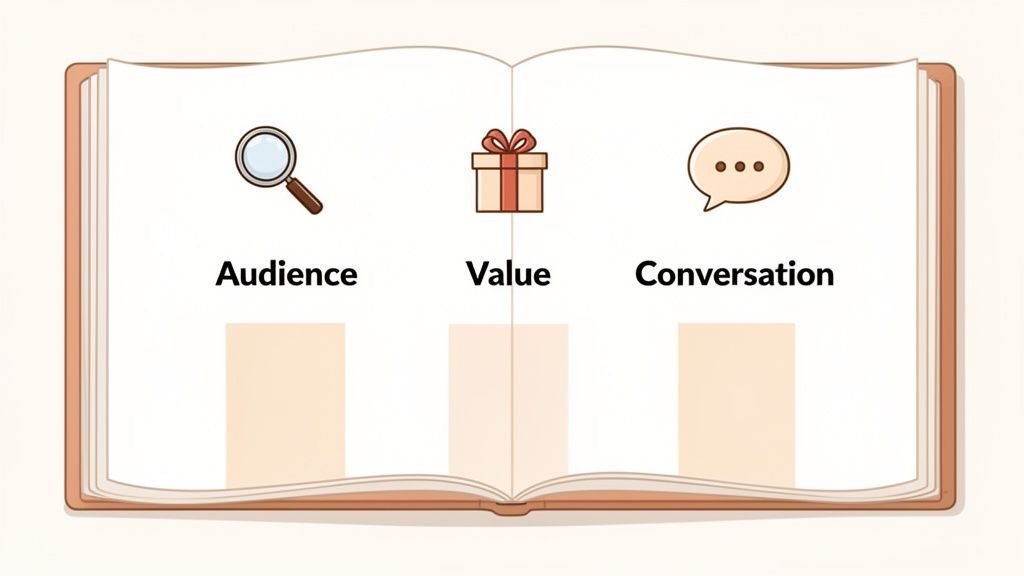
A powerful engagement strategy really comes down to three core pillars. Think of them as the active ingredients in every successful social media account. Mastering these is your first step toward building a thriving online presence.
Here's a quick-start table that breaks down these fundamental principles.
| Pillar | Core Principle | Actionable First Step |
|---|---|---|
| Audience | Go beyond demographics to truly understand your followers’ pain points, goals, and the language they use. | Spend 30 minutes reading comments on popular accounts in your niche. Note recurring questions. |
| Value | Ensure every post provides something in return for your audience's attention, whether it's a tip, a story, or a laugh. | Before you post, ask yourself: "If I were my ideal follower, would I save or share this?" |
| Conversation | Treat engagement as a two-way street by actively participating in and starting discussions. | Commit to replying to every new comment within the first hour of posting. |
When you nail these three pillars, you're building a foundation that not only attracts followers but keeps them coming back for more.
The goal is to create a feed where every interaction feels like a real conversation, not a broadcast.
When people feel genuinely connected to your brand, they don't just consume your content—they become your biggest advocates. You'll stop pushing content at an audience and start pulling a community in.
In the sections ahead, we’ll break down exactly how to put these pillars into action with practical tactics for audience research, content creation, community management, and measurement. Let's get to it.
Know Your Audience, Plan Your Content
Great social media engagement is never an accident. It’s the result of a solid plan built on a simple truth: you have to know who you’re talking to before you can expect them to listen. This goes way beyond basic demographics. You need to get inside their heads.
Before you even dream up a post, you have to understand their world. What problems are they trying to solve? What are their biggest goals? What makes them laugh? Answering these questions is the first real step in figuring out how to increase engagement on social media, because it lets you create content that actually feels like it was made for them.
Go Deeper Than Demographics
Demographics tell you who your audience is (their age, location, etc.), but psychographics tell you why they tick. This is where the real gold is.
- Pain Points & Frustrations: What are the common struggles they face? For a software company, this might be the frustration of dealing with slow, clunky tools.
- Goals & Aspirations: What do they ultimately want to achieve? A fitness coach’s audience might dream of running their first 5k or just having more energy for their kids.
- Online Habits: Where do they spend their time online? Pay attention to the influencers they follow, the accounts they tag, and the type of content they’re already saving and sharing.
This deeper understanding is your secret weapon. When your content speaks directly to what drives them, it forges an instant connection that makes likes, comments, and shares feel effortless.
Key Insight: You aren't just making content for a faceless "audience." You're starting a conversation with a real person. Try building a detailed persona—give them a name, a job, and a list of their biggest challenges and dreams.
How to Build Your Audience Persona
You don't need a massive research budget to gather this intel. A few smart tactics can give you everything you need. Start by using social listening tools to keep an eye on keywords and brand mentions. See what people are saying about your competitors and the industry as a whole.
Another incredibly powerful method is to look at the data you already have. Your DMs and comment sections are packed with clues. If you're looking for a structured way to sort through all that feedback, learning how to analyze qualitative research data can help you spot trends and pull out real insights from those messy, unstructured conversations.
And finally, just ask. A quick two-question survey in your Instagram Stories or a simple poll in a Facebook Group can give you direct, honest feedback on what your audience actually wants from you.
Turning Insight into a Content Plan That Works
Once you have a crystal-clear picture of your audience, you can build a content plan that’s designed to serve them. This is how you stop posting randomly and start ensuring every single thing you create has a purpose. The best way to structure this is with content pillars.
Content pillars are the 2-4 core themes your brand will own. These topics should live at the intersection of what your brand does best and what your audience cares about most.
Example Content Pillars for a Financial Advisor:
| Pillar | Audience Pain Point Addressed | Example Content Idea |
|---|---|---|
| Debt Reduction Strategies | Feeling buried by student loans or credit card debt. | A carousel post breaking down the "avalanche vs. snowball" method. |
| Investing for Beginners | Being scared of the stock market and having no idea where to start. | A Reel explaining what an index fund is in under 60 seconds. |
| Mindful Spending | Struggling with impulse buys and lifestyle creep. | A poll asking followers about their biggest spending trigger. |
With these pillars locked in, you can build out a content calendar that mixes formats—videos, carousels, text posts, and Stories—to keep your feed dynamic. This strategic approach ensures you’re not just shouting into the void; you’re consistently delivering value that connects with the exact people you want to reach.
Habits That Consistently Improve Engagement
Post Timing Strategy
Posting when your audience is most active dramatically improves early engagement. Analyze your platform insights to identify peak activity hours and schedule posts accordingly to increase visibility and interaction.
Comment Seeding
Initiate the conversation by posting the first comment immediately after posting the content. This comment can be the continuation of the post, which helps the audience respond to the post.
Content Series
Create recurring post formats such as “Tip Tuesday”, “Weekly Insights”. Familiar content series make audiences anticipate your posts and increase repeat engagement.
Micro-Value Posts
Not every post needs to have high value. Micro-value posts, which address one problem, have more chances of success because they can be easily consumed.
Crafting Content That Captures Attention and Inspires Action
You’ve done the research and have a solid plan. Now for the fun part: creating content that actually gets people to stop scrolling and pay attention. Great engagement isn't a fluke; it's the result of a simple but powerful structure that combines a killer hook, real value, and a clear call to action.
Nailing this down is the secret to figuring out how to increase engagement on social media.
Your audience's attention is your most precious asset. You have about three seconds to convince them your post is worth their time. That's where the hook comes in.
Seize Attention with Irresistible Hooks
The hook is your opening line, the first frame of your video—its only job is to stop the scroll. It needs to scream, "This is for you, and it's worth it." Don't make people guess; give them a reason to stick around.
Here are a few proven hook formulas you can steal and adapt:
- Ask a Challenging Question: "Are you making this common mistake with your morning coffee?"
- Share a Surprising Statistic: "Did you know that 80% of people ditch their New Year's resolutions by February?"
- Make a Bold or Contrarian Statement: "Stop setting goals. Do this instead."
- Start with a Relatable 'You' Statement: "You know that feeling when you have a dozen great ideas but can't focus on any of them?"
These work because they spark curiosity, challenge what people think they know, or just feel incredibly relevant. The goal is to make someone think, "Okay, I need to know more."
Deliver Tangible Value and Tell a Story
Once you’ve got their attention, the rest of your post has to deliver on that promise. This is the "meat"—the solution, the insight, or the laugh you offered. The best way to serve it up? Wrap it in a good story.
People connect with stories, not data points. Instead of just listing facts, put them inside a narrative.
Instead of: "Our new software increases productivity." Try: "I used to waste an hour every morning just sorting through emails. Then I discovered a simple workflow that changed everything, and it gave me back five hours a week."
This approach makes your content stick. It’s relatable, memorable, and helps your audience see themselves in the solution you're offering. To get this done efficiently, it helps to have the right content creation tools for social media in your back pocket.
Key Takeaway: Your content should do one of two things: educate or entertain. If it doesn’t solve a problem, answer a question, or make someone smile, it’s probably not going to get much interaction.
Inspire Action with a Powerful CTA
The final piece of a high-performing post is the call-to-action (CTA). This is where you tell your audience exactly what to do next. A post without a CTA is like a conversation that just fizzles out—a massive missed opportunity.
Forget the tired "link in bio." A great CTA is specific, easy to follow, and designed to start a conversation.
- Ignite Debate: "Agree or disagree? Tell me why in the comments."
- Encourage Sharing: "Share a photo of your workspace using #MyProductiveSpace for a chance to be featured!"
- Invite Personal Stories: "What's one piece of advice that has stuck with you? Share it below."
- Prompt Specific Actions: "Save this post so you don't forget these tips."
- Drive Amplification: Learning how to quote retweet and get more engagement on a platform like X can be a huge boost. You can encourage this with a CTA like, "Quote this with your biggest takeaway."
When you combine a sharp hook, genuine value wrapped in a story, and a clear CTA, you've created a complete package. It’s content that not only grabs attention but drives the kind of interaction that both algorithms and real people love.
Unlocking Engagement with Smart Content Repurposing
Feeling the pressure to create fresh content every single day is a fast track to burnout. The good news? You don't have to. The smartest way to drive engagement is to stop working harder and start working smarter by repurposing the great content you already have.
Think of your long-form audio and video—podcasts, webinars, interviews—as a goldmine for an endless supply of high-performing social posts.
Video is the undisputed king of social media engagement. The data for 2025 is clear: short-form video drives the most interaction. TikTok leads the pack with a massive 3.70% engagement rate, the highest of any platform. On Instagram, Reels now account for 35% of all time spent on the app, and carousels (which can include video clips) consistently outperform single-image posts.
Why Video Content Dominates Social Media?
Short videos remain a dominant performer, beating almost every other content type on social media. Social platforms like TikTok, Instagram Reels, and YouTube Shorts are built with a priority on video content in their algorithms. For creators and brands, this means video content has the power to reach more people and gain higher engagement compared to other types of content.
But this doesn't mean you need to chain yourself to a camera. It means you need a system. A repeatable workflow to squeeze every drop of value from the content you’ve already poured your heart into.
The Power of a Repurposing Workflow
The concept is brilliantly simple: take one big piece of content and slice it into dozens of bite-sized assets perfect for social media. This approach doesn't just save you a ton of time; it guarantees your social feed is packed with consistent, high-value content.
Your mission is to find the "aha" moments hidden in your recordings. We’re talking about the hot takes, the powerful insights, the funny asides, or the actionable tips that can stand alone as compelling 30-to-60-second clips.
Tools That Make Content Repurposing Faster
State-of-the-art AI
Powered by OpenAI's Whisper for industry-leading accuracy. Support for custom vocabularies, up to 10 hours long files, and ultra fast results.

Import from multiple sources
Import audio and video files from various sources including direct upload, Google Drive, Dropbox, URLs, Zoom, and more.
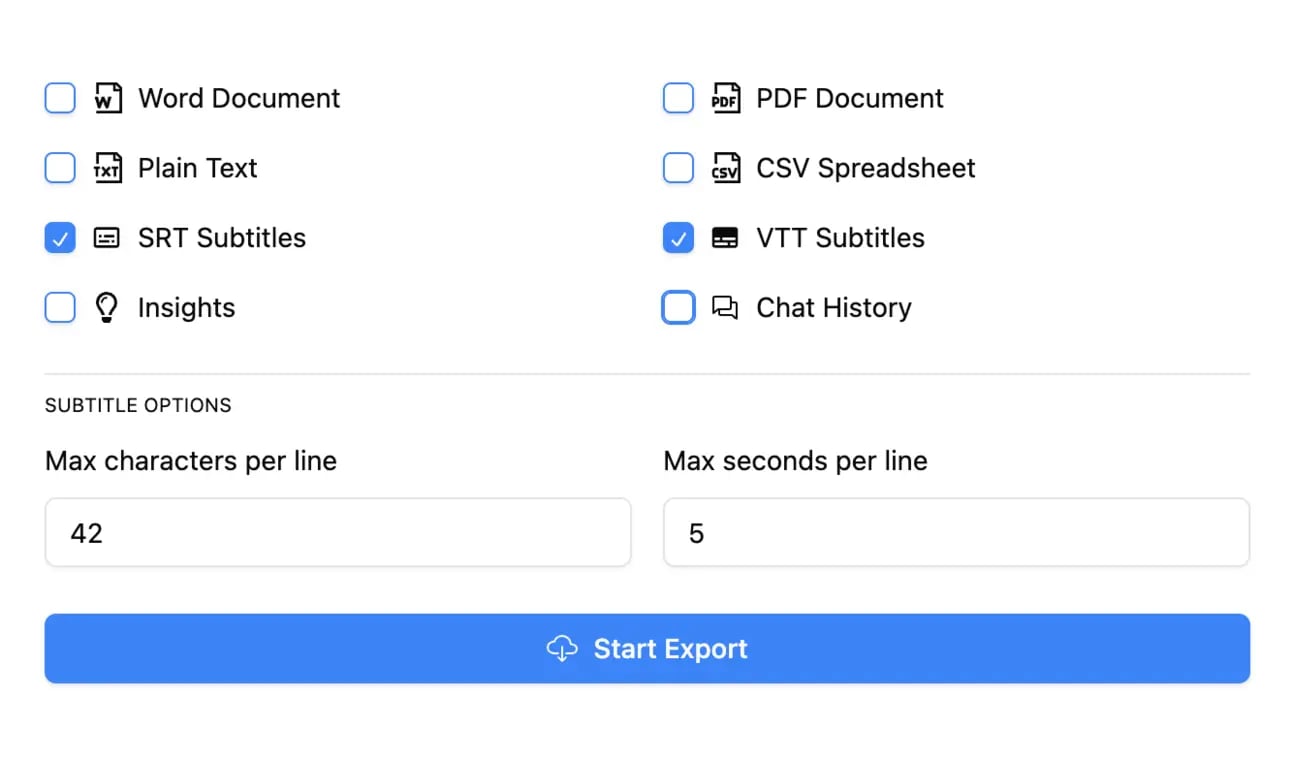
Export in multiple formats
Export your transcripts in multiple formats including TXT, DOCX, PDF, SRT, and VTT with customizable formatting options.
A Step-by-Step Guide to Repurposing Video
This is the exact workflow that can turn a single one-hour video into an entire week's worth of social media posts. Once you get the hang of it, this process will become the backbone of your content strategy.
- Transcribe Your Long-Form Content: First things first, get a word-for-word transcript of your audio or video. An AI tool like Transcript.LOL makes this incredibly fast. Instead of wasting time scrubbing through a timeline, you get a clean, searchable document in minutes.
- Identify the Golden Nuggets: With the transcript in hand, you can scan for the most potent segments. Look for powerful quotes, surprising stats, or moments where you explained a complex idea perfectly. Highlight these—they're your future social media posts.
- Clip and Edit: Once you've found your clips, use the timestamps in the transcript to instantly locate and cut them from the original video. Each clip should be short, punchy, and laser-focused on a single idea.
Features That Help You Extract More Value From Content
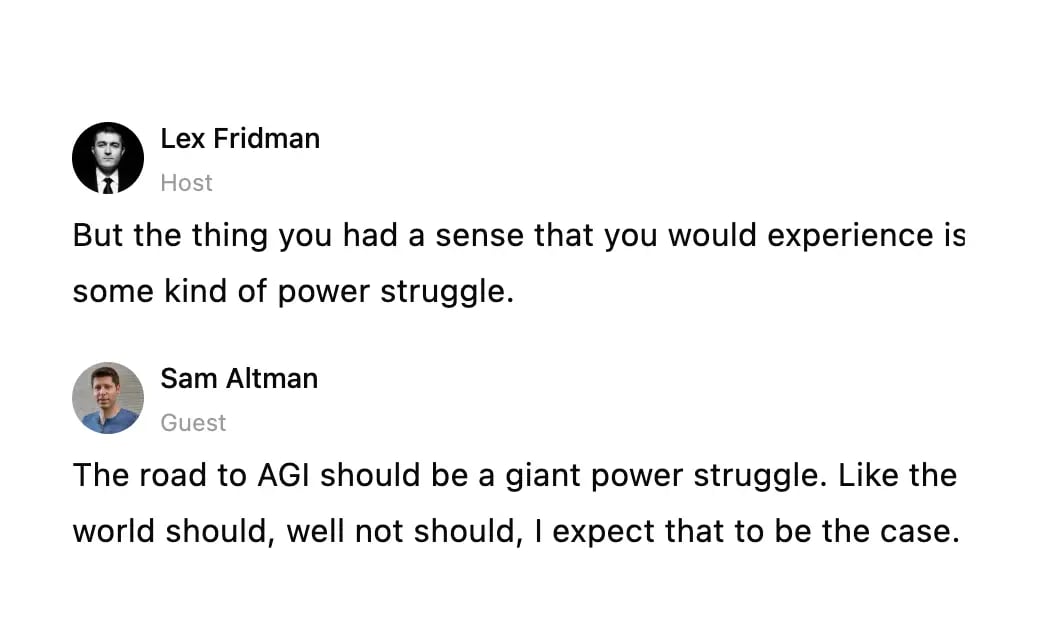
Speaker detection
Automatically identify different speakers in your recordings and label them with their names.
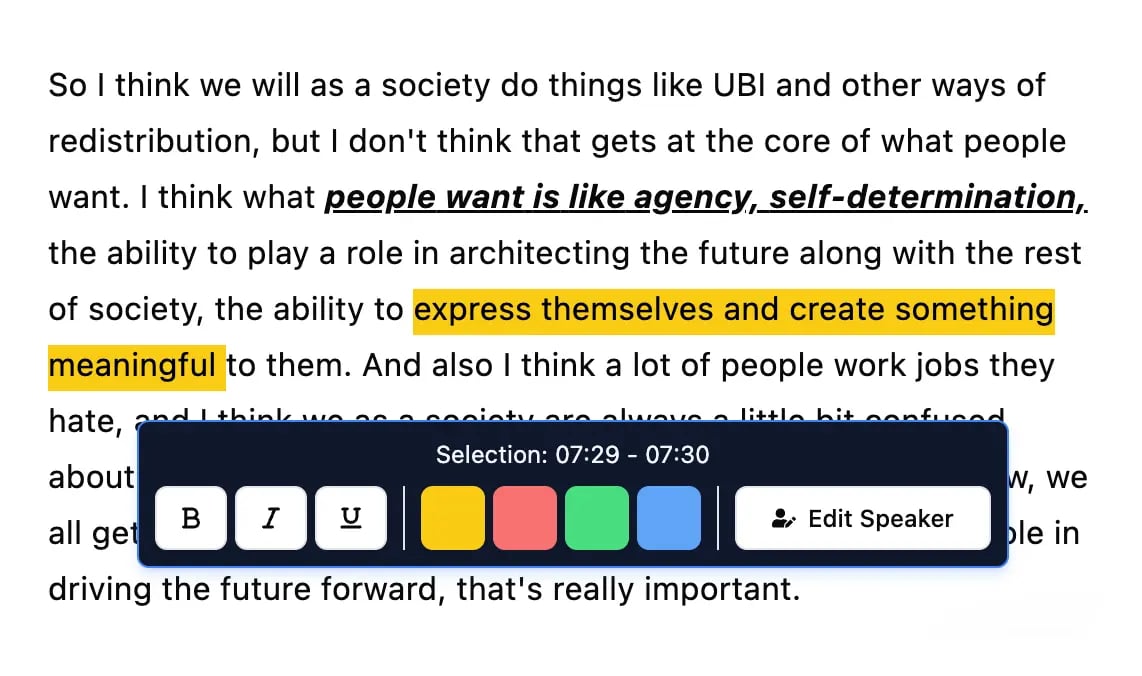
Editing tools
Edit transcripts with powerful tools including find & replace, speaker assignment, rich text formats, and highlighting.
Summaries and Chatbot
Generate summaries & other insights from your transcript, reusable custom prompts and chatbot for your content.
By mastering this process, you’ll build a library of micro-content that’s always ready to go. To dig deeper into this, check out our complete guide on effective content repurposing strategies.
Captions Are Absolutely Non-Negotiable
Once your clips are ready, there’s one more critical step: adding captions or subtitles. This isn't an optional extra anymore; it's a fundamental requirement for engagement. A huge number of users—think people scrolling in public, at work, or late at night—watch videos with the sound off.
Without captions, you are actively choosing to lose a massive part of your potential audience. With them, you make your content more accessible, easier to understand, and dramatically increase watch time.
Ignoring Captions Leads to Low Involvement of Audience
Some users watch social media videos without sound. If our videos don’t contain captions or subtitles, viewers may skip or scroll past our video without understanding the message. Adding captions improves watch time and keeps users engaged.
This one simple addition can transform a silent, skippable video into something truly captivating.
Below is a visual breakdown of the essential components that make these repurposed clips so effective.
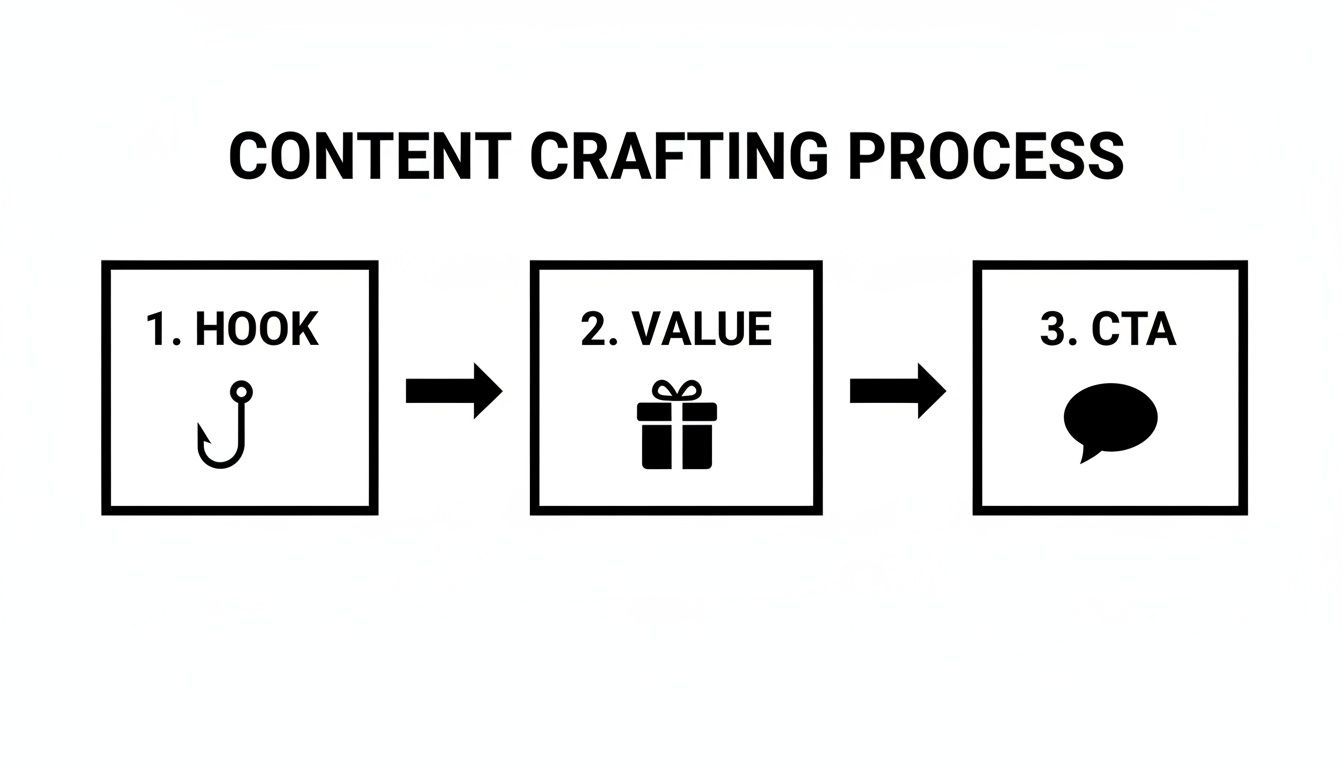
This simple model shows the anatomy of a perfect social post. It needs a strong hook to stop the scroll, clear value to hold attention, and a direct call to action. By turning your long-form recordings into focused micro-clips, you're essentially creating dozens of these perfect posts from a single piece of content.
Building and Nurturing a Thriving Online Community
Posting great content is only half the battle. If you’re just broadcasting messages into the void, you’re missing the entire point of social media. Real, sustainable growth kicks in when you stop talking at your audience and start building with them.
This is where you shift from being a publisher to a community manager. Engagement is a conversation, and the brands that actually grow are the ones who show up to participate. This is how you figure out how to increase engagement on social media—by making every single follower feel seen and heard.
Turn Comments and DMs into Conversations
Your comment section isn't just a feedback box. It’s a goldmine of potential relationships. It’s easy to drop a generic "Thanks!" or a quick emoji, but that’s a dead end. Treat every comment as an invitation to talk.
A thoughtful response can turn a casual follower into a true fan. Ask a follow-up question, share a related resource, or just acknowledge their point with something personal. It shows a real human is paying attention, which is surprisingly rare.
Your Direct Messages (DMs) are even more valuable. When someone takes the time to slide into your DMs, they're signaling a high level of interest. A prompt, personal reply here builds a level of trust and loyalty that a public post simply can’t achieve.
Don’t Wait for People to Come to You
Community building is not a passive sport. You can't just post and pray. You have to go out and find the conversations. Set aside time every day to engage with your followers' own content. A like is nice, but a thoughtful comment on their post is 10x more powerful.
This proactive approach does two critical things:
- It humanizes your brand. You become part of the community, not just another account trying to sell something.
- It boosts your visibility. By interacting on other relevant accounts, you organically expose your brand to new audiences who are likely to be interested in what you do.
When you treat your audience like collaborators instead of consumers, they become invested in your success. Every interaction is a deposit into your brand’s relationship bank.
Use Interactive Content to Build Community at Scale
Beyond one-on-one replies, you can use specific content formats to create a community vibe that includes everyone. These posts invite participation and make your audience feel like they belong to a group.
- Run Insightful Polls: Use Instagram Stories or LinkedIn polls to get opinions on industry topics, ask for input on your next piece of content, or just post something fun. Polls give everyone an incredibly easy way to participate.
- Host Live Q&As: Go live on Instagram, TikTok, or YouTube to answer questions in real time. This creates an unscripted, direct line of communication that puts a real face to your brand. It’s raw, it’s authentic, and people love it.
- Celebrate User-Generated Content (UGC): This is the holy grail of community engagement. Actively encourage your followers to create content featuring your product or brand, maybe with a unique hashtag. Then, reshare the best posts and give the creator full credit. It’s the ultimate social proof and makes your audience feel like celebrated partners.
By consistently weaving these strategies into your workflow, you’ll transform your social media feed from a simple content channel into a buzzing, interactive hub where your best followers feel right at home.
Measuring What Matters to Optimize Your Strategy
If you want to actually grow your social media engagement, you have to stop posting into the void and start listening to what your data is telling you. Creating great content is just one piece of the puzzle. The real secret is understanding why certain posts work so you can build a repeatable system for success.
This means looking past vanity metrics like follower counts. Instead, focus on the actions that show you have a genuinely engaged audience. Think of your analytics as a direct feedback loop. When you see high numbers of saves and shares, it’s a clear signal that your content is so valuable people want to reference it later or vouch for it to their own network. That’s much more powerful than a simple like.
Defining Your Key Engagement Metrics
Every platform's analytics dashboard can look intimidating, but you really only need to track a few key performance indicators (KPIs) to get a clear picture of what’s happening. These are the numbers that tell the real story of how people interact with your work.
- Engagement Rate by Reach: This is your most honest metric. It tells you the percentage of people who actually saw your post and took action, giving you a true measure of how compelling it was.
- Shares: A share is a personal endorsement. When someone puts your content in front of their audience, it’s a massive vote of confidence and a huge driver of organic reach.
- Saves: When someone saves your post, it means your content is practical, useful, or inspiring. They see it as a resource worth returning to—a strong sign you've created something of high value.
- Comment Sentiment: Don't just count comments; read them. Are people asking thoughtful questions and sharing personal stories, or are they just dropping single-word replies? The quality matters.
These metrics look different on every platform, which helps you decide where to focus your energy. For instance, engagement rates aren't universal. The average can be anywhere from 1.4% to 2.8%, but the platform-specific numbers are what really matter: TikTok crushes it with a 3.70% rate, while Instagram's 0.48% is still more than three times higher than Facebook's 0.15%. You can see a full breakdown of these platform-specific engagement statistics on Hootsuite's blog.
A Simple Framework for A/B Testing
Once you start tracking these core metrics, you can start making systematic improvements with A/B testing. It’s a simple process of comparing two versions of a post to see which one performs better, taking all the guesswork out of your strategy.
The goal of A/B testing is to make small, incremental improvements that compound over time. By testing one variable at a time, you can isolate what truly drives engagement for your specific audience.
Start with a basic hypothesis. For example: "I think a question hook will get more comments than a statement hook." To test this, you'd create two almost identical posts, changing only that first line in the caption. You can do the same thing with different visuals, calls-to-action, or even the specific clips you choose from a longer video. For a deeper look at that, check out our guide on how to time stamp a video for maximum impact.
By regularly analyzing what works and testing new ideas, you create a powerful cycle of optimization. This data-backed approach is how you consistently create content that doesn’t just get seen—it gets results.
Your Social Media Engagement Questions, Answered
As you start putting these strategies into play, a few common questions always seem to pop up. Let's tackle some of the finer points you might be wondering about.
How Often Should I Really Be Posting?
This is the big one, right? The truth is, there’s no magic number. It all comes down to your specific audience and the platform you're on.
The Real Secret: Consistency beats frequency, every single time. It's far better to share three high-quality, genuinely engaging posts per week than to pump out seven mediocre ones just to hit a quota.
Think about it this way: On a fast-paced platform like X, posting multiple times a day can work. But for a professional network like LinkedIn, 2-3 thoughtful posts a week is usually more than enough to stay visible without annoying your connections.
How Should I Handle Negative Comments?
Getting negative feedback never feels great, but it’s a golden opportunity. The absolute worst thing you can do is ignore or delete the comment (unless it's clear spam or abuse, of course).
The best approach? Respond publicly, but keep it calm and professional. Acknowledge their point, thank them for the feedback, and offer to move the conversation to DMs to sort it out. This simple act shows everyone watching that you listen and care, often turning a bad experience into a public display of great customer service.
Which Metrics Actually Matter for a Small Business?
It’s easy to get buried in data. For a small business, you need to ignore the vanity metrics and focus on the numbers that signal a real connection with your audience.
Here’s what I recommend tracking:
- Engagement Rate by Reach: This tells you the percentage of people who saw your post and actually did something—liked, commented, or shared. It’s the truest measure of how interesting your content is.
- Saves and Shares: These are high-intent actions. A share is a personal recommendation, and a save means your content was so good someone wants to come back to it later. That's a huge win.
- Website Clicks: If your goal is driving traffic, this is your bottom-line metric. It shows whether your social media efforts are actually getting people to take that next step.
Focusing on these deeper metrics gives you a much clearer picture of what’s working and what’s actually helping your business grow.
Ready to turn your best video and audio content into dozens of engaging social posts? With Transcript.LOL, you can instantly get accurate transcripts, identify the most compelling clips, and generate summaries or social-ready text in seconds. Start transcribing for free at Transcript.LOL and unlock your content's full potential.