A Better Meeting Minutes Format with Action Items
Transform meetings from talk to action. Learn a better meeting minutes format with action items, get practical tips, and download our free template.
Kate, Praveen
December 13, 2023
A great meeting minutes format isn't just about taking notes; it's about creating a blueprint for what comes next. The best ones I've seen always have clear sections: who was there, what was on the agenda, the meat of the discussion, what was decided, and—most importantly—a dedicated table for action items that spells out who's doing what and by when.
Why Most Meeting Minutes Fail to Drive Action

Let's be real. How many times have you walked out of a meeting, felt a brief surge of momentum, and then… nothing? You get back to your desk, the emails pile up, and the great conversation you just had fades into the background.
This isn't a personal flaw; it's a breakdown in the system. Traditional minutes often read like a transcript, a passive record of who said what. They're stuck documenting the past instead of driving future action. This is exactly how projects stall, deadlines get missed, and teams start feeling like their time is being completely wasted.
The Real Cost of Inaction
This isn’t just a small frustration. It has a massive financial ripple effect. Ineffective meetings are estimated to cost the U.S. economy around $37 billion every single year. Worse, surveys show that roughly 65% of people feel their time in meetings is consistently squandered.
The root of the problem? A complete lack of accountability. When the next steps aren't clearly defined, assigned to someone, and tracked, they just fall through the cracks. This is where a simple, strategic shift in how you document your meetings can change everything.
The purpose of meeting minutes is not just to remember what was said, but to ensure something gets done. Shifting from passive recording to active task management is the single most effective way to turn conversations into tangible progress.
Learning how to run effective meetings is the foundation, and your minutes are the tool that ensures follow-through. An action-focused format bridges that critical gap between talking and doing. It's not about creating more bureaucracy; it’s about making sure the work you're already putting in actually leads somewhere. When you focus on clear, accountable next steps, your minutes stop being a simple record and become the command center for your project.
Anatomy of an Action-Oriented Minutes Template
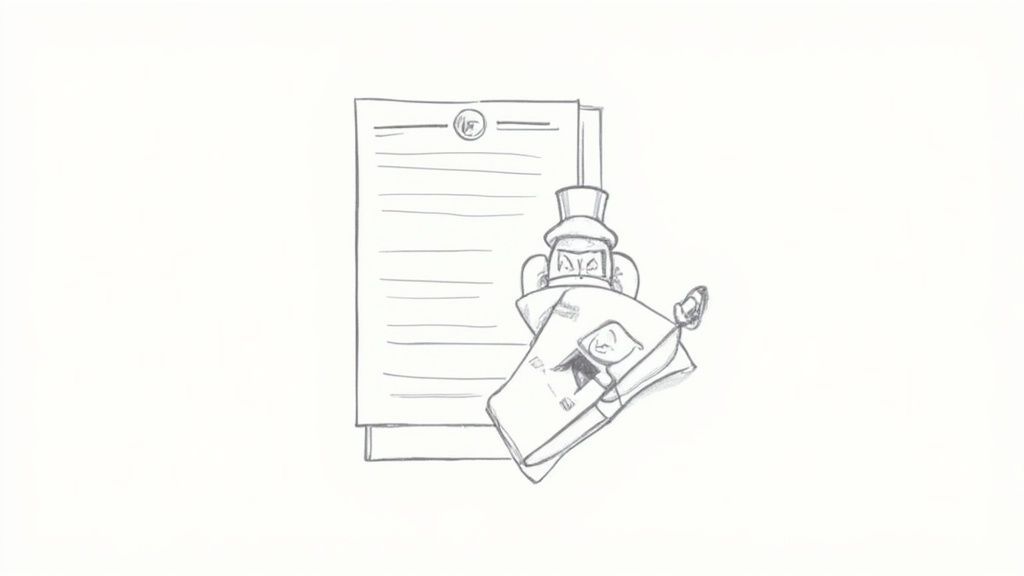
Let's break down what a truly useful meeting minutes template looks like. Forget generic checklists. Think of this as a blueprint for clarity, where every single section has a specific job.
This isn’t about rigid rules. It's about creating a document that guides the reader from the big picture right down to who's doing what by when.
First, you have to nail the basics. This stuff seems obvious, but it provides instant context for anyone who missed the meeting or needs a refresher weeks later.
- Header Information: Always include the meeting title, date, and time. Also, list who was there and, just as importantly, who wasn't.
- Link to Agenda: Don't waste time recapping the agenda in the minutes. Just drop a link to the original document so it’s easy for everyone to find.
With that out of the way, you can get to the real substance of the meeting. The goal here is to capture the important outcomes, not a word-for-word playback of the entire conversation.
Capturing Key Discussions and Decisions
Your discussion notes should be a tight summary. What were the main arguments? What key data was shared? What was the general consensus on each agenda item? Skip the personal opinions and stick to the facts.
Right after that summary comes the most critical part for accountability: the Decisions Made section. This needs to be a crystal-clear, impossible-to-misunderstand list.
Don't bury decisions inside a long paragraph of notes. Always pull them out into their own distinct, bulleted list. It makes them scannable and serves as a quick reference for the future.
For instance, a decision should read something like this: "Decision: The Q4 marketing budget will be reallocated, moving an additional $5,000 from paid search to content creation." That level of clarity prevents so many arguments down the line.
Given that employees spend an average of 11.3 hours per week in meetings, making these documents fast and easy to digest is a huge win for everyone.
The Action Items Table
Finally, we get to the engine of your meeting minutes: the action items table. This is where you turn all that talk into traction. A good action items table leaves zero room for confusion.
To help you get this right every time, here’s a quick-reference table breaking down the essential components.
Core Elements of an Effective Meeting Minutes Format
| Component | Purpose | What to Include |
|---|---|---|
| Action Item | Clearly defines the task to be completed. | Start with a strong verb like "Create," "Draft," or "Research." Be specific. |
| Owner(s) | Assigns clear responsibility to an individual or group. | List the actual name(s) of the person accountable. No ambiguity. |
| Due Date | Sets a firm deadline for completion. | Provide a specific date (e.g., EOD Friday, Oct 25). Avoid vague terms. |
| Status | Tracks the progress of each task over time. | Keep it simple: Not Started, In Progress, or Complete. |
This structured format transforms your minutes from a static record into a living project management tool.
For more technical teams, where tracking tasks and decisions is paramount, you can find more specific advice in our guide to creating effective engineering meeting notes.
How to Write Action Items That Actually Get Done
Let's be honest: the action items section is where the magic really happens in your meeting minutes. It’s the part that turns a good chat into actual, tangible progress. If this section is weak, all that great discussion just fizzles out, and nothing changes.
You've probably seen a weak action item before. It looks something like: "Look into new marketing software." It’s vague, has no clear owner, and no deadline. It’s practically designed to be forgotten.
A strong action item is the complete opposite. It’s so clear you can't possibly misunderstand it. Think of it as a mini-project plan packed into one powerful sentence.
The SMART Framework in Practice
The best way to get there is by using the SMART framework: Specific, Measurable, Achievable, Relevant, and Time-bound. This isn't just corporate buzzword bingo; it's a super practical checklist for making sure things actually get done.
- Specific: Kick off every action item with a verb. Don't just write "Marketing report." Instead, try: "Draft the Q3 marketing performance report."
- Owner: Every single task needs a single owner. Even if a whole team is working on it, one person has to be the point person. This kills the "I thought someone else was doing it" excuse.
- Deadline: Give it a real, concrete due date. "Sometime next week" isn't a deadline. "By EOD Friday, October 25th," is.
When you nail these three things, you create a clear path forward.
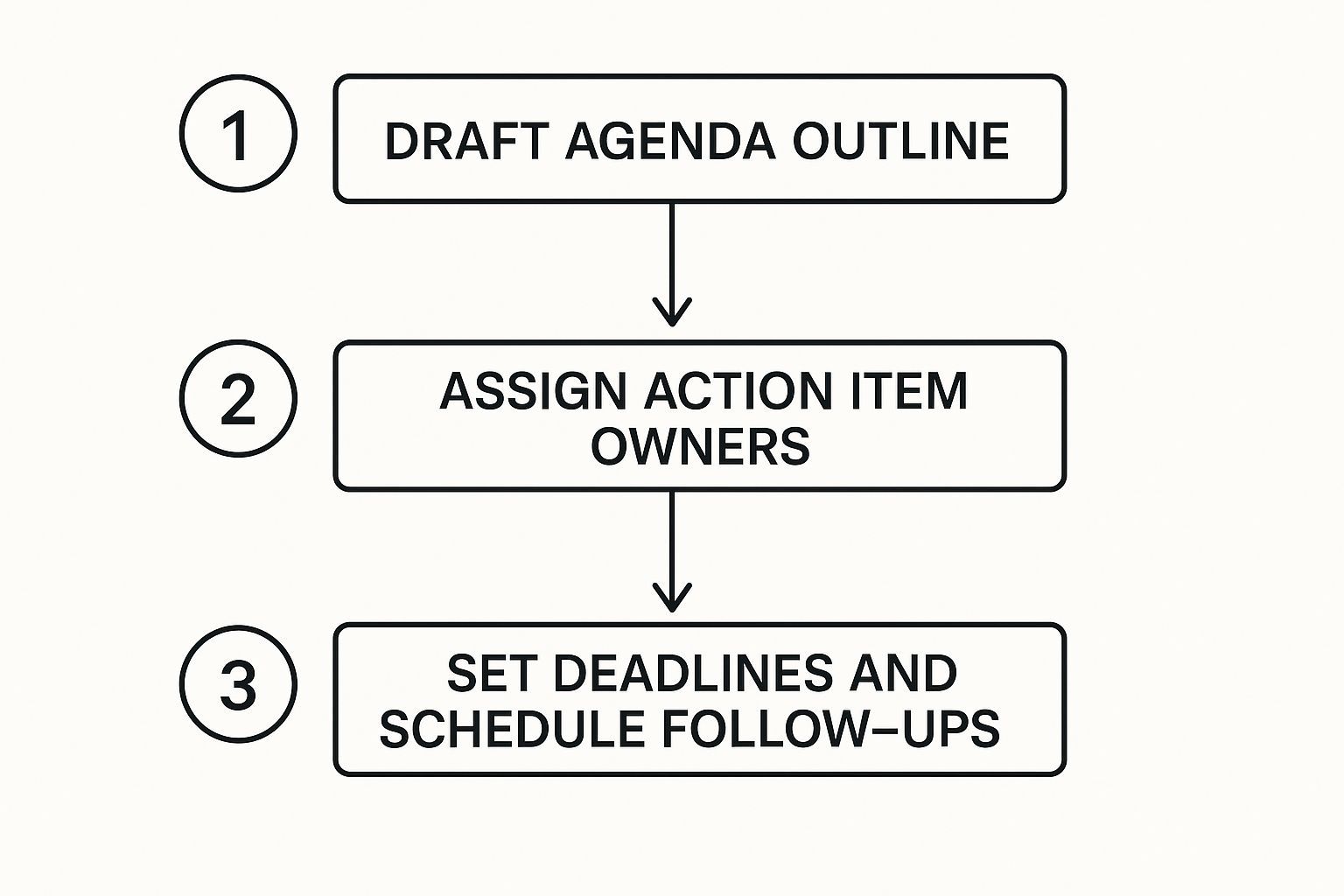
As you can see, assigning an owner and a deadline is what truly brings your meeting minutes to life.
Before and After Examples
Let’s look at a quick transformation.
Before: Someone needs to handle the client feedback from the survey. After: Chris to analyze the Q3 client survey feedback and present a summary of the top three concerns by the project sync on Monday.
See the difference? The "after" version leaves no room for confusion. We know who's doing it, what they're doing, and when it's due. Once you have a list of solid action items, you can plug them into effective priority management systems to keep everything on track.
If you’re juggling back-to-back meetings, trying to catch every single detail can feel impossible. This is where an online meeting transcription tool can be a game-changer. It ensures you never miss a commitment, turning spoken agreements directly into a documented plan. Stick with this structure, and you'll see your team's follow-through improve almost overnight.
Best Practices for Recording and Sharing Minutes
Having a great template for your meeting minutes is a fantastic start, but it's only half the story. The real magic happens when you turn that structure into a consistent habit, transforming messy conversations into clear outcomes.
This process kicks off the second the meeting begins. Remember, your job isn't to be a court stenographer, capturing every single word. You're a strategic filter. Focus on pulling out the crucial bits—the final decisions, the "who does what by when," and the key takeaways. Using a template from the get-go helps you slot this information into the right place without losing the thread of the conversation.
Get Them Out Fast and Ask for Feedback
Once the meeting wraps up, you’re on the clock. My rule of thumb? Get those minutes out to all attendees within 24 hours. Any longer, and the details start to get fuzzy in everyone’s minds.
Sending them out quickly does more than just ensure accuracy. It signals that the action items are important and that you expect people to follow through. It’s a subtle but powerful way to build a culture of accountability.
A prompt, clear summary prevents memory fade. When minutes are sent a week later, they become a historical document. When sent the same day, they become an immediate action plan.
I also recommend building in a quick feedback loop. Just ask everyone to give them a once-over for any corrections or clarifications. This simple, collaborative step makes sure the final version is a true record of what was decided and that everyone is on the same page.
Find a Permanent, Searchable Home for Your Minutes
Don't let your hard work get buried in an email thread, never to be seen again. Where your minutes live after they're finalized is just as important as how they're written. You need a central, searchable spot for them.
Here are a few solid options I've seen work well:
- Shared Drives: Simple, but it works. A dedicated folder on Google Drive or OneDrive, organized by project or date, is a classic for a reason.
- Project Management Tools: This is my preferred method. Tools like Asana, Trello, or Jira are perfect because you can link the minutes directly to the tasks you've just created. It closes the loop.
- Internal Wikis: If you use something like Confluence or Notion, creating a knowledge base for past decisions is a game-changer. It makes it incredibly easy to find context later on.
Think about the sheer volume of virtual meetings happening. Zoom alone hosted 3.3 trillion meeting minutes in just one year. Without an organized system, your team's most important decisions are just digital dust in the wind.
For a deeper dive, check out these 8 Steps to Effective Meeting Minutes Documentation. And if you're dealing with more complex sessions, knowing the ins and outs of training workshop transcription can seriously level up your documentation game.
Your Downloadable Template and a Real-World Example
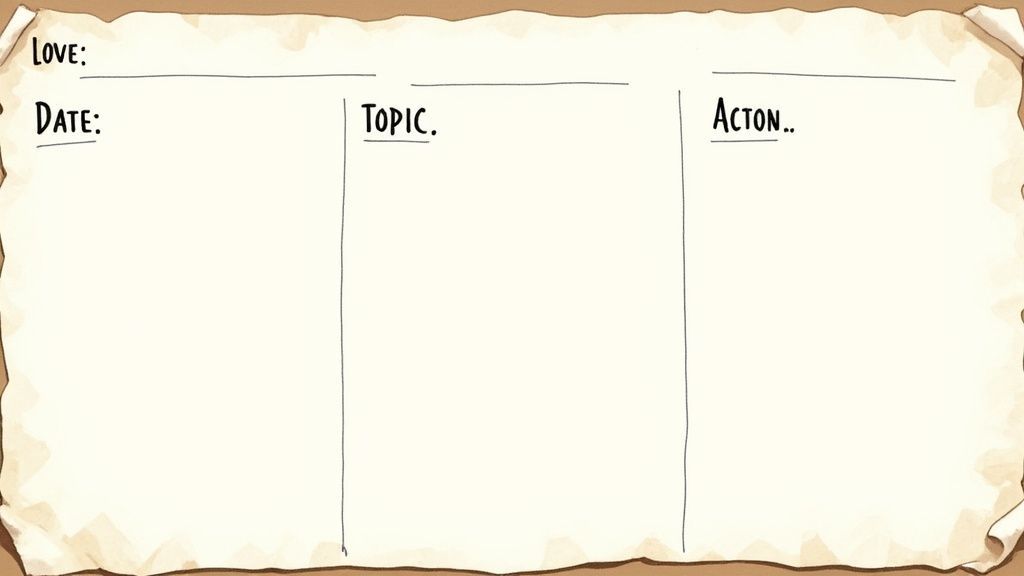
Okay, theory is one thing, but having a solid template you can actually use is what really counts. I’ve put everything we've talked about into a clean, professional format you can grab and start using right away.
It's a complete meeting minutes format with action items built-in.
- Download as a Google Doc
- Download as a Word File
To show you how it works in the real world, I’ve also filled one out. The example covers a typical quarterly marketing sync, so you can see exactly how to note down the important discussions, key decisions, and those crucial next steps.
Seeing the blank template next to the filled-in example is where it all clicks. You'll see how the structure works in practice, taking all the guesswork out of the process. It's a proven framework you can adapt for your own team starting today.
Common Questions About Meeting Minutes and Action Items
Whenever you introduce a new way of doing things, questions are bound to pop up. That’s a good thing. Getting everyone on the same page with a new meeting minutes format is all about building confidence and making sure the process actually works for your team.
Let's walk through a couple of the most common questions I hear, from how much detail to include to who should even be taking notes in the first place.
How Detailed Should Meeting Notes Be?
This is the big one, and the answer usually surprises people: probably less detailed than you think. You’re aiming for clarity, not a full-blown transcript. The goal is to capture the outcomes of the conversation, not every single word that was said.
Think about what really matters:
- Decisions Made: What did the team actually agree on?
- Key Insights: Any specific data points or "aha" moments that swayed the decision?
- Action Items: Who is doing what, and what’s the deadline?
Everything else is probably just noise. Your minutes should be a scannable document that anyone can read to quickly understand what happened and what comes next.
A classic rookie mistake is treating minutes like a movie script. Don't. Think of them as the executive summary of your meeting. The less clutter you have, the more your action items will pop.
Who Should Be in Charge of Taking Minutes?
Ideally, you should rotate this responsibility. If the same person is always stuck taking notes, they often can't participate as fully in the discussion. Sharing the load keeps everyone engaged and helps the whole team get comfortable with the process.
That said, for really important, high-stakes meetings, it can be a smart move to assign the role to someone who isn't a key decision-maker in that specific discussion. This allows them to focus 100% on getting the details right without feeling the pressure to contribute their own opinions.
In fields where capturing every nuance is vital, like therapy or counseling sessions, professionals often need a more robust solution. Specialized tools can help document these discussions accurately while allowing them to stay present. You can see how important secure therapy and counseling transcription is in these sensitive situations.
At Transcript.LOL, our AI platform automatically pulls out summaries, key decisions, and a neat list of action items right from your meeting recordings. It frees you from manual note-taking so you can focus on the conversation, confident that nothing important will get lost. Learn more at https://transcript.lol.