6 Indispensable Conversation Transcription Example Use Ca...
Explore a definitive conversation transcription example list for podcasts, meetings, and legal use. See how to achieve perfect transcripts every time.
Kate
February 15, 2026
In a world driven by audio and video content, the ability to convert spoken words into accurate, searchable text has become indispensable. But what does a high-quality transcript actually look like? The answer varies dramatically depending on the context. A legal deposition demands a different format and level of detail than a podcast show note, and understanding these nuances is key to creating a truly useful document.
This guide provides a detailed conversation transcription example for six common scenarios, moving beyond generic templates to offer strategic analysis. We'll break down the raw AI output, showcase a professionally cleaned version, and provide actionable tips for achieving similar results using simple tools. This process not only makes your content more accessible but also unlocks its full potential. As we unpack the power of transcription to convert raw audio into perfect text, it's worth exploring the hidden power of captions for accessibility, SEO, and engagement.
You’ll learn not just what to look for, but how to create transcripts that serve your specific goals, whether it's for legal compliance, content marketing, academic research, or customer service excellence. Let's dive into the anatomy of a perfect transcript.
Features That Make Transcription Effortless
State-of-the-art AI
Powered by OpenAI's Whisper for industry-leading accuracy. Support for custom vocabularies, up to 10 hours long files, and ultra fast results.

Import from multiple sources
Import audio and video files from various sources including direct upload, Google Drive, Dropbox, URLs, Zoom, and more.
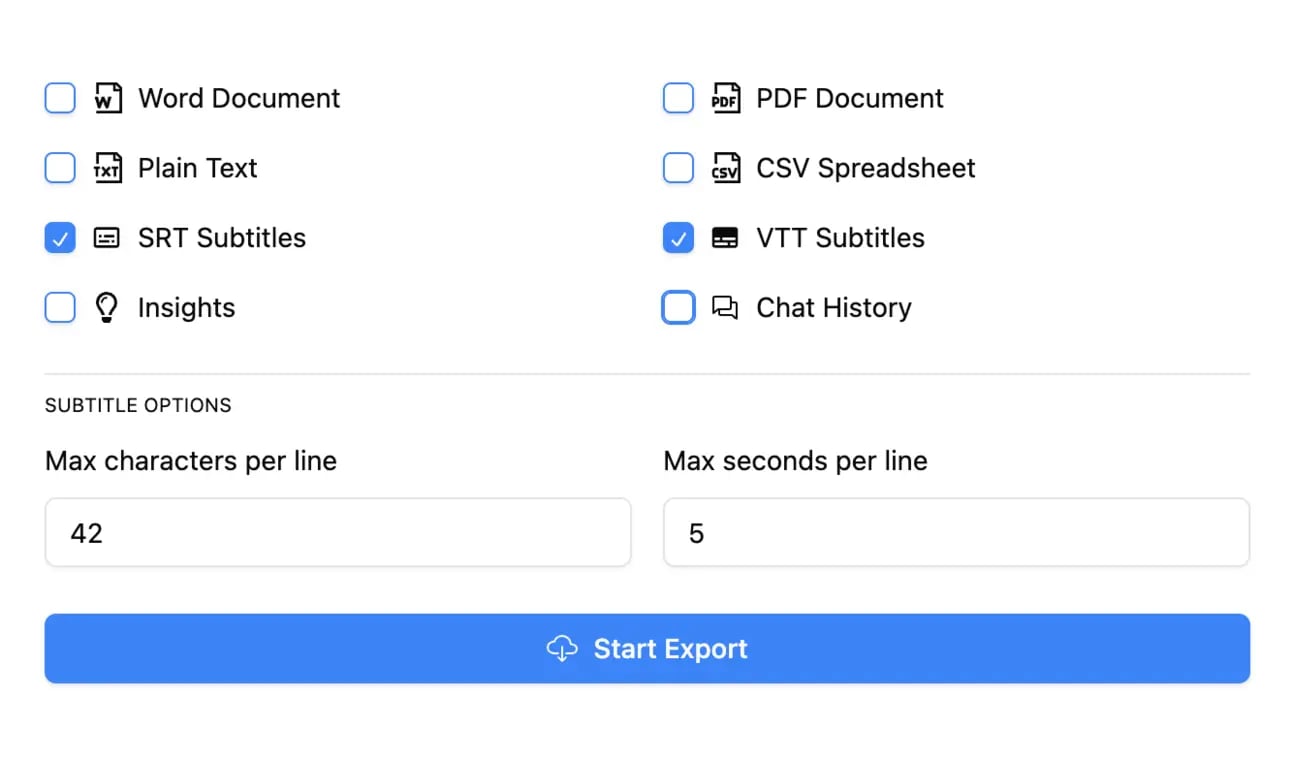
Export in multiple formats
Export your transcripts in multiple formats including TXT, DOCX, PDF, SRT, and VTT with customizable formatting options.
1. Customer Service Call Transcription
A customer service call transcription is a verbatim text record of a phone or video conversation between a support agent and a customer. This type of conversation transcription example is crucial for businesses aiming to enhance quality assurance (QA), refine agent training, and maintain meticulous compliance records. By converting spoken interactions into searchable text, companies can analyze dialogue, identify trends, and ensure service standards are consistently met.
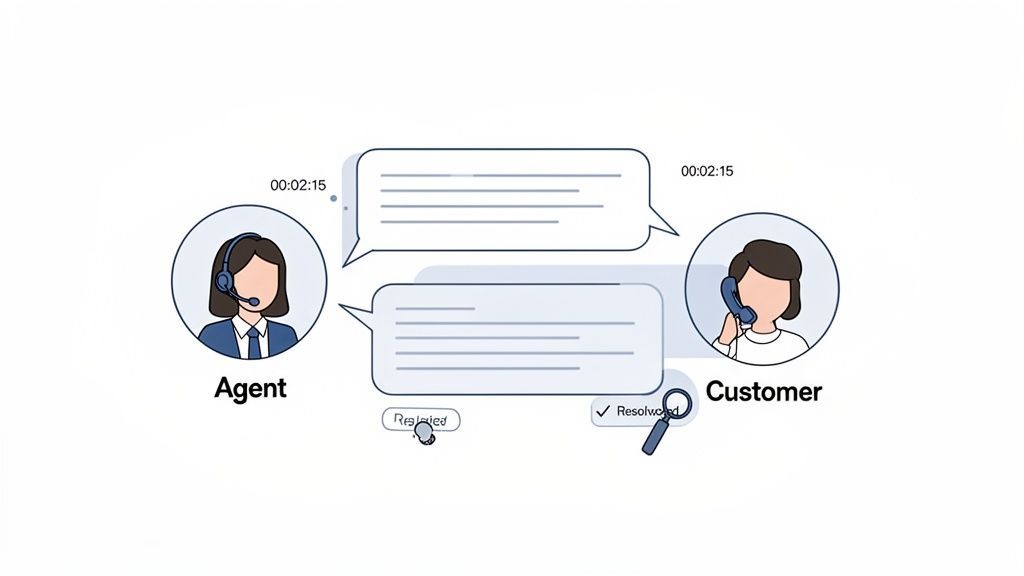
This method is widely adopted across various industries. For instance, banking institutions review mortgage application calls to ensure regulatory compliance, while SaaS companies analyze technical support interactions to improve their knowledge base and product features. The core value lies in creating an objective, easily accessible record of every customer touchpoint.
Why Text Beats Audio for Analysis?
Audio is hard to scan, quote, or search. Once conversations become text, teams can instantly find issues, measure trends, and extract insights. That single shift turns raw calls into actionable data.
Why It’s a High-Quality Example
Customer service transcripts are a prime example of turning unstructured audio data into actionable business intelligence. They move beyond simple call logging to provide deep insights into customer sentiment, agent performance, and recurring issues. This allows for data-driven decisions rather than relying on anecdotal feedback. The structured format, complete with speaker labels and timestamps, makes it easy for QA teams to pinpoint specific moments in a conversation for review.
Actionable Tips for Implementation
To effectively use customer service transcriptions, follow these best practices:
- Ensure Compliance: Always obtain and record explicit consent from customers before recording any conversation to comply with privacy laws like GDPR and CCPA.
- Automate Labeling: Use a tool with robust speaker detection, like Transcript.LOL, to automatically differentiate and label the agent and customer. This saves significant manual editing time.
- Leverage Search and Summaries: Utilize the search function to quickly locate calls mentioning a specific product or issue. Generate AI-powered summaries for managers to get a quick overview of the interaction without reading the entire transcript.
- Build a Custom Vocabulary: Improve transcription accuracy by adding industry-specific jargon, product names, and acronyms to a custom vocabulary list.
By implementing these strategies, businesses can transform their customer support operations. Understanding the cost-effective plans available can help teams of any size get started. You can explore a variety of transcription pricing options to find the best fit for your needs.
2. Podcast Episode Transcription
A podcast episode transcription is a complete text version of an audio or video podcast. This type of conversation transcription example is invaluable for creators looking to maximize their content's reach, accessibility, and search engine discoverability. By converting spoken interviews and discussions into a readable format, podcasters can repurpose their content, engage a wider audience, and build a searchable archive of their work.
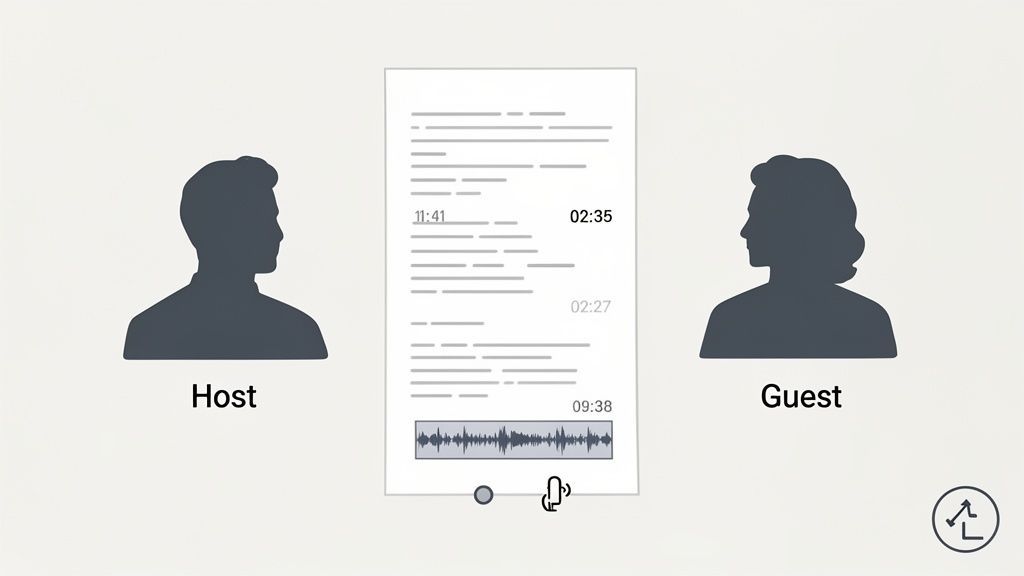
This practice is standard for top-tier podcasts like The Joe Rogan Experience and the Lex Fridman Podcast, which use transcripts to make their extensive conversations accessible and searchable. Similarly, educational shows like TED Radio Hour provide full transcripts to complement their audio, reinforcing learning and allowing audiences to reference key information. The primary goal is to unlock the value trapped in audio-only files, making it a powerful content marketing tool.
How Transcripts Multiply Your Content Value?
Discoverability
Search engines can’t index audio, but they can read text. Transcripts make every spoken word searchable and SEO-friendly. This brings long-term organic traffic to your content.
Repurposing
One episode becomes blogs, emails, clips, and social posts. You extract quotes and highlights instantly. Content creation becomes faster and more consistent.
Accessibility
Captions and transcripts support deaf, hard-of-hearing, and multilingual audiences. Everyone can consume your content comfortably. Inclusivity naturally expands your reach.
Knowledge Retention
Readers skim, highlight, and revisit key points anytime. Important ideas aren’t lost in long recordings. Learning and comprehension improve dramatically.
Why It’s a High-Quality Example
Podcast transcripts are a stellar example of how to multiply the value of a single piece of content. They transform an ephemeral audio experience into a durable digital asset that search engines can index, boosting SEO and driving organic traffic. The inclusion of speaker labels and timestamps makes the content easy to navigate, allowing listeners to find specific segments or quotes without scrubbing through audio. This enhances user experience and makes the content accessible to deaf and hard-of-hearing audiences.
Actionable Tips for Implementation
To get the most out of your podcast transcriptions, implement these strategies:
- Automate Speaker Identification: Use a tool with advanced speaker detection, like Transcript.LOL, to automatically distinguish between hosts and guests. This saves countless hours of manual labeling, especially for interview-style or multi-host shows.
- Export for Subtitles: For video podcasts on platforms like YouTube, export the transcript in SRT or VTT format to create accurate closed captions. This improves accessibility and viewer engagement.
- Create Repurposed Content: Pull compelling quotes and key takeaways directly from the transcript to create social media posts, blog articles, and email newsletters, extending the life of your episode.
- Build a Custom Vocabulary: Improve accuracy by adding recurring guest names, brand-specific terms, and technical jargon to a custom vocabulary. This ensures proper nouns and specialized language are transcribed correctly every time.
By using these techniques, you can turn your podcast into a multifaceted content engine. You can check out various transcription pricing options to find a plan that scales with your production schedule and budget.
3. Corporate Meeting and Board Meeting Transcription
A corporate meeting transcription is a precise, verbatim record of discussions from internal gatherings, executive briefings, or board meetings. This type of conversation transcription example is indispensable for creating an official account of strategic decisions, assigned action items, and key deliberations. By converting audio from these critical sessions into text, organizations establish a single source of truth for compliance, governance, and internal alignment.
This practice is standard in highly regulated industries and large enterprises. For instance, a publicly traded company uses board meeting transcripts to document shareholder resolutions and ensure SEC compliance. Similarly, a tech startup might transcribe a C-suite strategic planning session to capture every nuance of a product pivot, ensuring all executives are aligned on the new direction and their responsibilities. The primary goal is to create an accurate, searchable archive for accountability and future reference.
Why It’s a High-Quality Example
Corporate meeting transcripts are a powerful tool for transforming spoken strategic discourse into a structured, permanent asset. They provide an objective record that eliminates ambiguity or reliance on individual memory, which is crucial when high-stakes decisions are made. The ability to document who said what, along with specific commitments, fosters a culture of accountability. A well-formatted transcript with speaker labels and timestamps allows for quick verification of votes, motions, and assigned tasks, making it a cornerstone of effective corporate governance.
Don’t Rely on Manual Notes
Handwritten or partial notes miss context and critical decisions. Small details often disappear after the meeting ends. Without a full transcript, accountability breaks down quickly.
Actionable Tips for Implementation
To maximize the value of corporate meeting transcriptions, consider these best practices:
- Integrate with Meeting Platforms: Use a service with a native Zoom or Microsoft Teams integration to automate the recording and transcription process, ensuring no meeting is missed.
- Extract Action Items Automatically: Leverage AI-powered features to identify and pull out action items from the conversation. This saves time and helps in assigning tasks directly after the meeting.
- Ensure Confidentiality: Export transcripts to an editable format like DOCX to add confidentiality disclaimers or watermarks. Use secure, role-based access controls to manage who can view sensitive meeting records.
- Generate Executive Summaries: Create AI-generated summaries for stakeholders who were unable to attend. This allows them to grasp the key outcomes and decisions quickly without reading the full transcript.
By adopting these methods, organizations can enhance transparency, improve decision-making, and maintain meticulous records. Exploring the various business use cases for transcription can reveal more ways to integrate this technology across your operations.
4. Interview Transcript for Journalism and Research
An interview transcript for journalism and research is a precise, verbatim text record of a conversation between an interviewer and a subject. This specific type of conversation transcription example is fundamental for ensuring accuracy in reporting, verifying quotes, and preserving the full context of an exchange. For journalists, academics, and documentary filmmakers, these transcripts serve as the foundational source material for their work, allowing for meticulous analysis and ethical source attribution.
This practice is standard across investigative journalism outlets like ProPublica, academic institutions conducting qualitative research, and oral history projects aiming to archive personal accounts. Whether for a dissertation, a legal deposition, or a documentary film, the transcript provides an immutable record that can be referenced long after the original conversation took place, safeguarding the integrity of the final product.
Why It’s a High-Quality Example
Interview transcripts are a high-quality example because they prioritize accuracy and verifiability above all else. In fields where direct quotes and nuanced statements can completely alter the meaning of a story or research finding, a reliable text version is non-negotiable. It allows creators and researchers to easily search for key themes, pull exact quotes, and cross-reference information without having to scrub through hours of audio or video repeatedly. The structured format, with clear speaker labels and timestamps, makes the information easily navigable for fact-checking and editing.
Actionable Tips for Implementation
To maximize the value of interview transcripts for journalistic or research purposes, consider these best practices:
- Ensure Clear Speaker Separation: Use a tool with accurate speaker detection, like Transcript.LOL, to automatically distinguish between the interviewer and the subject(s). This is critical for attributing quotes correctly.
- Add Custom Vocabulary: Improve accuracy by creating a custom vocabulary list that includes the names of people, organizations, specific locations, and technical terms relevant to your subject matter.
- Utilize Search and Timestamps: Leverage the search function to instantly locate specific keywords or phrases within the interview. For video content, use timestamps to sync the transcript directly with the corresponding footage for easier editing.
- Export for Archival: Export the final transcript to formats like PDF or DOCX for easy archival, sharing with collaborators, and proper citation in academic papers or publications.
- Prioritize Security: For sensitive interviews, ensure you use a service with a strong privacy policy, such as a no-training guarantee on user data, to protect your sources and information.
By applying these tips, journalists and researchers can streamline their workflow and uphold the highest standards of accuracy. Exploring the right transcription tools can provide the features necessary to handle these demanding projects efficiently.
Workflow Features for Professional Teams
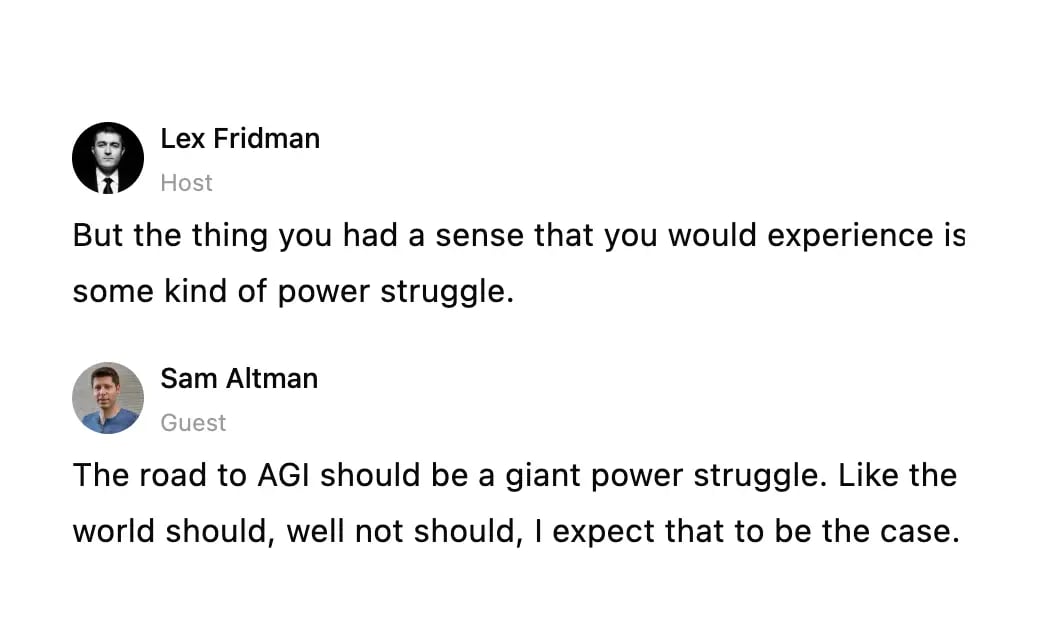
Speaker detection
Automatically identify different speakers in your recordings and label them with their names.
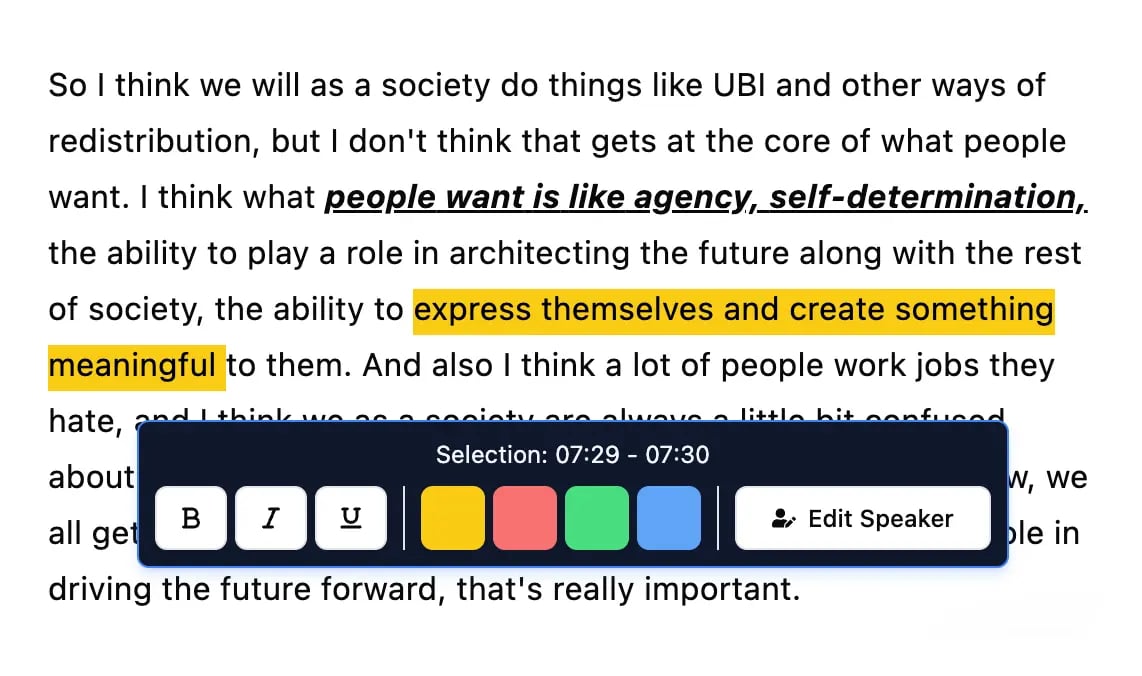
Editing tools
Edit transcripts with powerful tools including find & replace, speaker assignment, rich text formats, and highlighting.
Summaries and Chatbot
Generate summaries & other insights from your transcript, reusable custom prompts and chatbot for your content.
5. Educational Lecture and Classroom Transcription
Educational lecture transcription is the process of converting spoken academic content from university lectures, online courses, and workshops into a written text format. This type of conversation transcription example is vital for modern education, enhancing accessibility, aiding student comprehension, and creating permanent, searchable study materials. By transforming audio or video lectures into text, educational institutions can better support diverse learning needs and comply with accessibility standards like the ADA.
This practice is widespread in both traditional and online learning environments. For instance, platforms like MIT OpenCourseWare and Coursera provide transcripts alongside video lectures, allowing students to review complex topics at their own pace. Similarly, university disability services departments rely on transcriptions to provide reasonable accommodations for students, ensuring equitable access to course content. The primary goal is to make academic information more accessible, digestible, and reusable for everyone.
Why It’s a High-Quality Example
Educational transcripts are an excellent example of using transcription to democratize access to knowledge. They transform transient, spoken information into a persistent resource that empowers students to learn more effectively. Instead of struggling to take notes while listening, students can fully engage with the lecture, knowing a complete record is available. The structured format of a transcript, especially when timestamped, allows learners to quickly navigate to specific segments of a lecture to clarify concepts or prepare for exams.
Industry Shift Toward Automated Transcription
Schools, media teams, and businesses now expect transcripts by default. Manual typing is being replaced by AI-generated text in minutes. Fast, scalable transcription has become the new standard workflow.
Actionable Tips for Implementation
To maximize the benefits of educational transcriptions, consider these strategies:
- Improve Accuracy with Custom Vocabulary: Add course-specific terminology, complex scientific names, and instructors' proper nouns to a custom vocabulary list. This significantly enhances the accuracy of automated transcriptions.
- Generate Study Aids: Use tools like Transcript.LOL to automatically generate quizzes or mind maps from the lecture transcript. This helps students test their knowledge and visualize complex relationships between topics.
- Ensure Accessibility: Export transcripts in formats like VTT (Web Video Text Tracks) to add as closed captions or subtitles to video lectures on learning management systems (LMS) like Canvas or Blackboard.
- Facilitate Quick Reviews: Encourage students to use the search function to find mentions of key concepts or topics within a lecture series. This makes studying for exams far more efficient than re-watching hours of video.
6. Legal Deposition and Testimony Transcription
A legal deposition and testimony transcription is a precise, verbatim written record of sworn statements made during legal proceedings like depositions, hearings, and court trials. This type of conversation transcription example is fundamental to the legal system, serving as an official document for case preparation, evidence, and appeals. It captures every spoken word, including questions from attorneys, witness answers, objections, and judicial rulings, with uncompromising accuracy.
The creation of these transcripts is a standard practice in nearly all legal actions. For instance, in civil litigation, attorneys review deposition transcripts to prepare for trial and draft motions. In criminal cases, testimony transcripts are vital for appeals, ensuring the appellate court can review the exact language used in the original trial. The core purpose is to produce an official, unassailable record of verbal testimony.
Why It’s a High-Quality Example
Legal transcripts represent the gold standard for transcription accuracy and formatting. They transform spoken legal arguments and testimony into structured, citable documents that can withstand judicial scrutiny. Unlike more casual transcriptions, legal records must adhere to strict formatting guidelines and often require certification to be admitted as evidence. Their value lies in their absolute fidelity to the original audio, capturing nuances that are critical for legal interpretation.
Actionable Tips for Implementation
To produce and manage legal transcriptions effectively, precision and security are paramount:
- Prioritize Accuracy: Use a high-accuracy transcription model to capture complex legal terminology and case-specific details correctly. Ensure the tool can handle multiple speakers and background noise common in legal settings.
- Verify Speaker Identification: Manually verify that all speaker labels (e.g., "ATTORNEY 1," "WITNESS," "THE COURT") perfectly match the official list of participants. This is crucial for the document's legal validity.
- Use a Custom Vocabulary: Improve accuracy significantly by creating a custom vocabulary list. Add case names, legal jargon, expert witness names, and other proper nouns to prevent common transcription errors.
- Ensure Confidentiality: Choose a transcription service with a strict no-training policy to guarantee that sensitive and confidential testimony is never used to train AI models.
- Export for Legal Use: Export the final transcript to formats like DOCX or PDF that support page and line numbering, which is essential for legal citations and court filings.
By following these practices, legal professionals can create reliable records for their cases. You can explore how specialized tools are designed for these high-stakes environments and learn more about legal transcription solutions that prioritize security and precision.
Conversation Transcription: 6-Point Comparison
| Transcription Type | Implementation Complexity 🔄 | Resource Requirements ⚡ | Expected Outcomes 📊⭐ | Ideal Use Cases 💡 | Key Advantages ⭐ |
|---|---|---|---|---|---|
| Customer Service Call Transcription | Medium 🔄 — dual-speaker, timestamps, tone detection | Moderate ⚡ — call storage, secure retention, noise filtering | High 📊⭐ — QA, training, dispute evidence | Contact centers, support QA, compliance teams | Improves consistency; training material; dispute resolution |
| Podcast Episode Transcription | Low–Medium 🔄 — multi-speaker flow, chapter markers | Moderate ⚡ — long-form storage, editorial review | High 📊⭐ — SEO, accessibility, content repurposing | Podcasters, marketers, content teams | Boosts discoverability; quote extraction; social content |
| Corporate & Board Meeting Transcription | High 🔄 — many speakers, action-item & decision logging | High ⚡ — secure storage, integrations, access controls | High 📊⭐ — compliance, accountability, decision traceability | Executives, legal/compliance, project teams | Official records; action tracking; knowledge sharing |
| Interview Transcript (Journalism & Research) | Medium 🔄 — verbatim accuracy, precise timestamps | Moderate ⚡ — secure archiving, high-accuracy models | Very High 📊⭐ — verified quotes, research citations, archives | Journalists, researchers, academics | Ensures quote accuracy; fact-checking; archival integrity |
| Educational Lecture & Classroom Transcription | Medium 🔄 — Q&A capture, concept extraction, indexing | Moderate ⚡ — course-wide storage, vocab tuning, LMS exports | High 📊⭐ — accessibility, study guides, repurposing | Educators, students, LMS platforms | Accessibility compliance; study aids; quiz/mind-map generation |
| Legal Deposition & Testimony Transcription | Very High 🔄 — verbatim legal notation, certification needs | Very High ⚡ — certified workflows, strict security, review | Critical 📊⭐ — admissible records, appeals support, discovery | Law firms, courts, legal professionals | Legal-grade accuracy; citation-ready format; compliance guarantees |
Your Blueprint for High-Impact Transcripts
The journey through various real-world conversation transcription examples, from customer service calls to legal depositions, reveals a fundamental truth: context is king. A transcript is not merely a wall of text; it's a strategic asset whose value is unlocked by tailoring it to its intended purpose. The raw, unfiltered output from an AI is just the starting point, a block of marble waiting to be sculpted.
We've seen how a podcaster’s needs differ drastically from a legal professional’s. The former prioritizes SEO-rich content and accessibility with clean, readable text and clear speaker labels. The latter demands uncompromising verbatim accuracy, precise timestamps, and legally compliant formatting. This distinction highlights the core takeaway of this guide: effective transcription is about purposeful refinement. It’s about knowing when to clean up filler words for readability and when to preserve every "um" and "uh" for legal authenticity.
From Raw Data to Actionable Insights
The examples provided serve as a practical blueprint. They demonstrate that the transformation from a raw, machine-generated file into a high-impact document hinges on a few key actions:
- Strategic Cleaning: Identify your goal first. Are you creating a blog post, a legal record, or a research document? Your goal dictates your editing strategy, guiding decisions on verbatim vs. clean-read formatting.
- Intelligent Formatting: Leverage speaker labels, timestamps, and proper paragraph breaks. This structure turns a confusing dialogue into a clear, scannable, and usable resource.
- Purpose-Driven Exporting: The final format matters. An SRT file is essential for video captions, a DOCX is perfect for reports, and a simple TXT file offers maximum flexibility.
Mastering these steps means you're no longer just documenting what was said. You are creating a tool for deeper analysis, broader accessibility, and more efficient workflows. The true power of any high-quality conversation transcription example lies in its ability to be repurposed and analyzed to drive decisions and create value far beyond the original recording.
Choosing the Right Tools for the Job
Of course, the quality of your final transcript is heavily dependent on the platform you use. A powerful tool provides a high-accuracy foundation, minimizing the time you spend on manual corrections. To create high-quality, impactful transcripts, it's crucial to utilize the right software and services; learn about the top best transcription tools available to find a solution that fits your specific needs for accuracy, speaker identification, and export options. By starting with a superior AI-generated draft, you can focus your energy on the strategic refinements that truly matter.
Ultimately, viewing transcription as a dynamic, purpose-driven process rather than a static administrative task is the key to unlocking its full potential.
Ready to transform your own conversations into powerful, actionable assets? See the difference for yourself by trying Transcript.LOL. Our advanced AI provides the accurate, speaker-labeled foundation you need to quickly create the perfect transcript for any project. Get started with Transcript.LOL for free today!